Showing posts with label Postwar. Show all posts

Friday, March 18, 2022

The Scarlett Woman, Part 3: NOEL STREATFEILD (as SUSAN SCARLETT), Babbacombe's (1941) & Poppies for England (1948)


Just for a moment or two on her second day in the shop she sat down. A fellow-junior, called Jenny, gave her a horrified dig in the ribs.
"I say, get up before Mrs. Nunn or Miss Jones see you."
Beth sprang up.
"I thought we were allowed to sit. I mean I thought it was the Shop Act or something that we had to have something to sit on."
Jenny laughed.
"So they say, but it doesn't work out that way. You won't get sacked for sitting, but if you sit you'll get the sack."

For quite a while in my Susan Scarlett reading—both a decade or so ago when Greyladies first rediscovered them and more recently in my use of them to avoid reality—I resisted Babbacombe's. It has one of my least favorite plot elements—the utterly vicious, unredeemable, scheming girl who thinks herself "all that" and really should have been exposed on a hillside at birth. This was obvious even from the Greyladies blurb, and it led me to select other Scarlett titles instead. But it turns out this was a bit of a false alarm. Although there is such a character here, she is given delightfully little airtime, and her scheming is so obviously hopeless and without effect that one needn't really notice her at all.

The name of this character, however, will be quite familiar by the end of this post, as Streatfeild seems to have had a liberal recycling policy when it came to character names. Don't confuse the Dulcie of Babbacombe's with the Dulcie we'll meet in Poppies for England. But by all means do wonder if Streatfeild had at one time known someone named Dulcie and liked memorializing her every time she had a female character who was a pain in the neck.

At any rate…

Lovely young Beth Carson is just out of school and starting her first job at Babbacombe's department store, where her father has worked for donkey's years. Beth is pure as the driven snow, naturally, and always follows daddy's orders as far as knowing her place and keeping to it, but she can hardly be blamed for tripping over a charming young man's dog at the train station, can she? And how could she have helped getting trapped in an elevator with the same man a few days later, and giving him a piece of her mind about his attitudes, before learning that he just happens to be David Babbacombe, the ne'er-do-well son of the store's wealthy owner? How could she possibly have known that her careless words would inspire him to take a new lease on life? And is it her fault if he insists upon seeing her again despite her determined rejections due to knowing her place, etc.? 
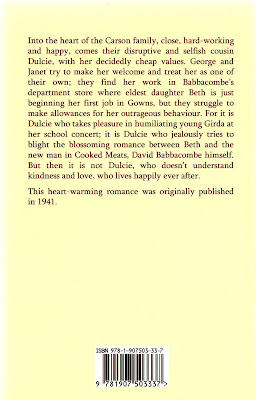

Starting work at Babbacombe's at about the same time as Beth, but as a lowly elevator girl, is Beth's useless cousin Dulcie, who has just been dumped on the Carsons by her aunt who raised her and has now had quite enough of her. Dulcie is spoiled, has some of her own money, and is a cheap glamour queen who fancies herself a seductress. But fortunately for the reader, she, like the Wicked Witch of the West, has no power here except as a minor irritant.

It all unfolds just as you'd expect, and the Carsons and Babbacombes are a delight to hang around (though a threatened-blindness subplot involving Beth's brother might well seem a bit too familiar from The Man in the Dark). As obvious and silly as it all often is, somehow—and who knows how Streatfeild does it, particularly seeing as how she was clearly to some extent "phoning in" these Susan Scarlett novels—it all rings true enough to make the novel a delightful frolic, and here as in the other novels we get wonderful details, this time of the day-to-day running of a department store, including Beth's efforts as a saleswoman, a nefarious shoplifter (and the surprising methods of a store detective), the strenuous running about of a junior, and the rigorous expectations of employers of the time for their staff. Not to mention a fairly thorough run-down of appropriate tips to staff after a stay in a country house—you never know when that might come in handy!


From the department store we move, in Poppies for England, to the stage, a subject Streatfeild knows well:

This one week's holiday was all that most of the audience could get, they were free for one week from food queues, housework and even, for many hours a day, the care of their children. It was a week of absolute rest, but everybody in the audience knew that outside the camp lay the hard, difficult world of 1946.

We're in the rather provincial theatrical world of a holiday camp for families in the immediate aftermath of World War II. The Corners and the Binns are show business families who are on the verge of dire straits due to the lack of jobs and the fact that both Arthur Binns and John Corners have spent much of the past several years as POWs in Japan. But the crisis is averted when they manage to adapt a show they conceived in their prison camp (sure, why not?) for the entertainment needs of vacationing families. All summer performing in the holiday camp, and with all their meals and accommodation provided, is quite a luxury after the difficult years of the war.

Dulcie Corners (there's that name again) has been the only member of the family with steady employment, but even she has been rather in a rut in the chorus of a West End show with no hope of stardom. She's ambitious, but also, of course, a bit of a diva, and when she sets her sights on the show's pianist and composer, Tom Pollard, gets not a flicker of interest out of him, then discovers that his interests really lie with Nella Binns, a dancer with real talent but no ability to "put herself over", danger signs start flashing.
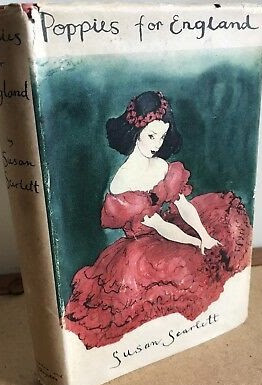
Not a great image, but fun to see
the original cover

You can more or less imagine the rest, but the main attractions here are twofold, or perhaps threefold. There's a lush array of details of wartime and postwar life. For example, there's Alice Corner's concerns that John must feel rather lost in the family's inside jokes, having been gone for several years:

It was difficult; she and the three children had such a wealth of things they shared, it was hard not to get talking and cut him out of a conversation. Silly, wartime jokes. That time Dulcie got under the table when the flying bomb hit the end of the street, and that time she had stood in a queue for two hours to buy strawberries, only to find that she was in the wrong queue and had fetched up at that peculiar chemist who had such odd things in his window that she always looked the other way when she passed, and that time when the house was blasted and they stayed for a week with the Binns, and that time when the Binns lost their windows and part of the roof and stayed nearly four months with them.

Even the song which becomes the hit of the show and gives the book its title is inspired by the war: "An airman had told him that the crimson streak of poppies was one of the loveliest things he knew coming home from a bomb raid."

Then, of course, there's wonderful details of the problems and perils of putting on a stage show, obviously grounded in Streatfeild's exact knowledge of that life. Just little details that she must have added by instinct shine with the ring of truth, as when Muriel Binns, who has added some pounds due to the stresses of wartime (oh, how I can relate), worries about her figure and the subtleties of an audience's reactions—"An out-and-out laugh she could stand, but never a snigger." 
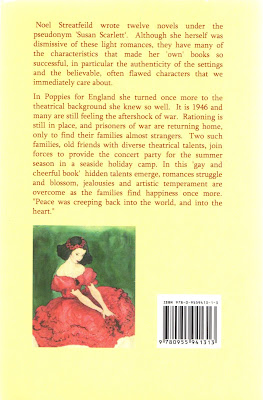

And finally, family stories are of course one of Streatfeild's best strengths as well, and the dynamics between the Binns and the Corners are completely charming. The Dulcie we meet this time is merely difficult and ambitious, not inhuman like the one in Babbacombe's, and the only really unfortunate element of this novel appears on the final page, with a rather unfortunate final line of "romantic" dialogue which might be seen as misogyny even though it's clearly intended as both humorous and loving. Some readers may find it jarring, others probably won't notice, but although I take it in the spirit it was intended, I rather wish it were worded a bit differently.

Similarly in terms of language, there's some unintentional irony in Dulcie's early comments on Tom's inexplicable lack of response to her charms: "Nobody can be like that really, can they? I mean, all men like women in the end, don't they, like all girls grow up to like boys?" And later: "I don't believe it's queer of me. I believe it's Tom that's queer."

Probably best if I refrain from comment…

Friday, February 25, 2022

The Scarlett Woman, Part 2: NOEL STREATFEILD (as SUSAN SCARLETT), Murder While You Work (1944) & Pirouette (1948)

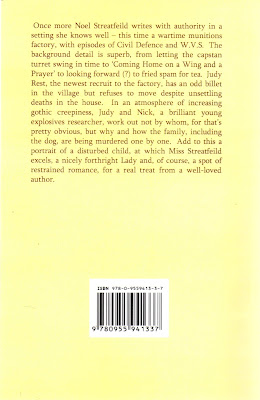
My lovely Greyladies edition of Murder

Judy sat staring out of the railway carriage window. Of course there was a war on, but could any train that was trying at all really dawdle the way this one was doing?

Now that I've got started reading and writing about Susan Scarlett (see here), I find that I can't stop, and in light of world events in the past few days it seems wise not to stop.

I read these two recently in a continuing desire to avoid any contact with reality. If I wouldn't say that these two are quite as good overall as Clothes-Pegs and The Man in the Dark, which I wrote about last time, they were still marvelously effective at getting my mind off the news.

Murder While You Work is one of two Susan Scarletts that are explicitly set during wartime (along with Summer Pudding, which I wrote about here ages ago). It's also Streatfeild's one attempt (to my knowledge) at a more or less straightforward murder mystery. So it might seem odd to say that this might have been the perfect Susan Scarlett novel if not for the damned murders, but that is indeed how I felt about it. 

Our heroine, Judy Rest, arrives in the village of Pinlock to take up her new work in a munitions factory. On the train, she makes the acquaintance of Nick Parsons when he rescues her dropped lipstick (quite valuable under wartime circumstances), who, it turns out after the two engage in some extremely careless talk, is also engaged in top secret work at the same factory. Nick, the only surviving son of the formidable Lady Parsons, whom we shall meet and come to love later on ("I was the child who was too delicate to live. And now look at the damn thing. The sole survivor."), warns Judy that he's heard disturbing things about her new billet, wherein a suspicious death has recently occurred. Da-da-da-DUM.


Judy is admirably unflappable, however (if a complete dolt when it comes to romance, as we shall see), and becomes fond of elderly, recently-widowed (in peculiar circumstances) Mrs. Former and her daughter Rose, though distinctly less fond of Clara Roal, Mrs. Former's niece, who is angry and disgruntled and more than a bit shady. Clara's son Desmond is a problem too, an eight-year-old with developmental or mental health issues that manifest in his apparently nonsensical speech and tendency toward cruelty. 

And then more murders occur. Unfortunately.

Judy is charming and intelligent and capable (except in regard to love, but that works itself out, of course), Nick is witty and brave and appropriately admires Judy for her capacities as well as her looks, and the wartime setting allows Streatfeild to pack the book with fascinating detail from her own experiences. All of that I loved, and to use my favorite expression for this type of reading, the pages turned themselves. I devoured it as readily as I am capable of inhaling a tub of cookies and cream ice cream, and I assure you that my capabilities in that area are impressive.

What, then, could possibly be wrong? It's just that the murder plot is purely an annoying interruption of an otherwise entertaining frolic. It's perfectly obvious from the beginning who the murderer is, it's the why and how that are (slightly) mysterious, and the victims are (breaking the golden rule of cozy mysteries) likable and harmless. One victim we only hear of, as he is dead when the novel opens, but the next is a sweet, charming supporting character that we have grown to like. Not to mention a dog… [cringe emoji]

If only instead of a boring murderer there might have been just an annoying person that Judy and Nick had to maneuver around. One gets the sense Streatfeild wanted to show off her knowledge of psychological issues by portraying a psychopath, but I could have lived without that display. There's also Desmond, whose portrayal is perhaps accurate from a psychological standpoint but is quite insensitive by today's standards (including a single use of the "r" word, along with various other only slightly less grating descriptions). His behavior is monstrous, but one can quite see how he got there and feel sad for his grotesque neglect.

Those reservations aside, however, the novel is an absolute delight. Nick's plucky mother, Lady Parsons, in herself makes up for most of the negatives, as for example in discussing her faithful housekeeper's fortunate age:

Dibble was my personal maid before the war, but now she does everything. Up till the war was declared Dibble went on from year to year being thirty-nine, and then suddenly, when registration started, she came to me one morning and laid her birth certificate on my desk and there she was fifty-two. Of course I said nothing about the thirty-nine, I was too thankful. I just said, 'Isn't that splendid, Dibble!' and she said, 'Yes, my lady,' and we've never mentioned it since."

The tidbits and interactions in the munitions factory are also a delight, as when Judy is instructed about maintaining the proper rhythm with her lathe ("The girls in this group say that 'White Christmas' just swings it nicely"). So while the unfortunate murders may keep this from being my favorite Susan Scarlett, it still lands fairly high up in the pile.

Next up:

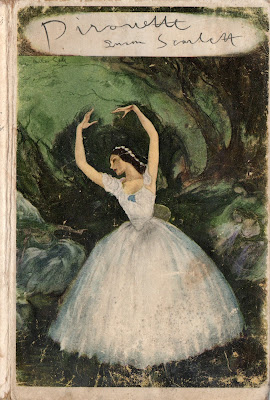
The rather lush original cover (never
mind the mildew stains)

"I've been watching you. Ever since you came to my school I've said to myself, 'There's something in that child which one day may, if she works, flower.' I'm now going to give you a chance to show the world what you can do. When I give a chance to one of my dancers I'm giving into their hands my reputation and the reputation of my school and of my ballet. Dancing is not, as with some of the other arts, a matter of short inspiration and quick effects; dancing is a vocation. A girl whom I choose to star as much gives her life to dancing as a novice entering a nunnery gives her life to religion."

Pirouette might land a little further down the pile for me—it's beginning to seem to me that the later Susan Scarlett novels have more angst and less cheerful energy than the early ones—and its focus on an 18-year-old ballet dancer on the cusp of stardom gives it a bit more of a feel of Streatfeild's children's books too, though it does contain a more or less effective romantic element. But of course center stage here is the ballet interest, and Streatfeild's intricate knowledge of a ballet company and of the dreams and frustrations of young dancers (and of the tyrannical instructors and directors who threaten to derail their lives). That's what makes this a page-turner despite it's unremarkable leading lady.

Judith Nell has been working and striving for success all her life, though this proves to have been as much due to her mother's own frustrated ambitions and her ceaseless pressure on Judith as to Judith's own wishes. Love in the Mist, the final Susan Scarlett novel, which I haven't yet reviewed, has a silly, misguided mother, no doubt, but Pirouette has one that should be promptly smothered with a pillow. Streatfeild's interest in obsessive and problematic personalities sometimes leads her to create exaggerated caricatures instead of characters, and Olive is a mother only a, er, masochist could love. Obsessed with Judith's success in a field she aspired to, Olive is at the point of completely ignoring her other children—Peter, having difficulty adjusting to life after serving in the war, and young Tim, in danger of getting involved in a gang because he feels neglected, not to mention her husband John, who has humored her in her obsessive attention to Judith but is now reaching the end of his rope. 

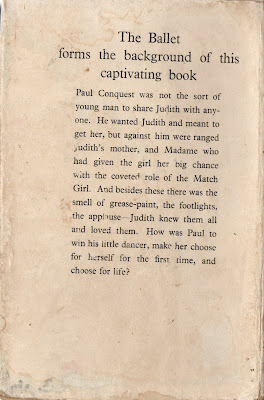
Original back cover

Of course, Judith falls in love with Paul, the brother of a fellow dancer, who is heading off to a good job in Rhodesia in a few months and wants to take her with him—just as she gets her big break in a starring role.

Some readers will cringe a bit at the book's ultimate attitude on the question of career vs. marriage and children, but of course no one can fairly expect radical political attitudes from a romance novel (though, expected or not, they have been known to creep in). As Paul sees it, "It was a damn' silly life, the ballet, sure to let her down in the end. Nobody wanted a wife with a career; it would be a far better thing if she could be persuaded to throw the whole thing up." And the irony of her father saying that Judith must make up her own mind about things as he advises Paul how to manipulate her is worthy of a cynical laugh.

But despite that, the tale has some irresistible elements. There's a delightful scene in which Prudence and Olga, two of the ballet company's stars, are deliciously catty to each other in a restaurant in front of their respective romantic interests. And one can't help but wonder if Streatfeild is making use of personal experience in the scene in which young Nadia, Paul's sister, having trained all her life for stardom but now heartbreakingly grown too tall, gives Madame Tania a brilliant telling-off that she won't soon forget. Those moments are well worth the bits of handwringing between Judith and Paul and Olive, and a plot that one can see coming a mile off.

Since I now have all the Susan Scarlett books waiting patiently on my shelves, and since the world news sure as hell isn't getting any better, I imagine I'll be reading more of them soon. Here's hoping they're all as entertaining as the ones I've read, even if none of them are likely to astonish me with their plot twists!

Friday, November 12, 2021

"My postwar face": MONICA STIRLING, Ladies with a Unicorn (1953)


"And then I was in love with Franchot Tone. I wrote to him and he sent me a signed photograph. Of course, I must say I'd enclosed a stamp. I can't tell you what looking at that photograph did for me. Then later on there was a boy at our A.R.P. post who was awfully witty if one hadn't read Oscar Wilde. But the first time he kissed me was a shocking disillusion. Not at all what Franchot Tone had led me to expect.''
Peggy obviously shot out this nonsense rather as a pursued octopus shoots out protective fluid.

Yes, I'm continuing my Monica Stirling odyssey, this time with one of her most successful and well-received novels, set amidst the glamour of the 1950s movie industry in Rome. Here we meet four women, three "of a certain age", all bearing in one way or the other the scars of World War II, and one a lovely young starlet of 18, soon to star in the latest film by Count Anton-Giulio Sarmento, who, though he barely appears on stage in the novel, is undoubtedly its main character (and the unicorn of the title).

Monica Stirling (author pic found
by Kim Kaso, thank you Kim!)

The novel is narrated by Françoise Joubert, an award-winning composer of music for Anton-Giulio's films. Widow of a Resistance fighter, and once a bright young thing herself, Françoise is now constantly aware of her stiff, unemotional face—her "mask"—the result of multiple plastic surgeries following horrific injuries in an air raid. Her telling of the story of a few months in Rome is wry and wise, though perhaps neither so wry or wise about the feelings she hides from herself.

The novel opens with Françoise contacted out of the blue by Peggy Latour, a beautiful former schoolmate who was never really a friend, but who wants to use their connection to get close to Anton-Giulio:

But as the steaming day slowly came to the boil I was gradually overcome by the masochism that obliges me to confront prewar acquaintances with my postwar face.

Peggy is entertaining but shallow, unsatisfied in her marriage to a wealthy Frenchman whose real life has turned out to be far tamer than their wartime experiences together. He spoils her, however, and allows her free use of his money, and she has decided that by financing Anton-Giulio's next film her life will become rather more eventful. She has also come under the influence of Princess Valeria Girafalcone, a cousin of the film director and a flamboyant "grande-dame" who believes that all women should be practically obligated to have lovers and lead decadent lifestyles.


Françoise in turn soon meets and befriends the lovely, naive Anna-Maria Minsell, the unknown daughter of a Soho organ grinder who will star in Count Anton-Giulio's latest film. The four women interact in various ways, with varying degrees of friendship, jealousy, resentment, and protectiveness, and most often on the topic of Anton-Giulio himself, toward whom each feels possessive and romantic, until finally, in the end, we find which way the wind is blowing from that quarter.

And that's that really. In some ways, it's the fluffiest, frothiest of novels, revealed almost entirely in dialogue—rather like Ivy Compton-Burnett adapted by Vincente Minelli. When I first read it, I thought the novel was irresistibly charming and entertaining but ultimately just a bit of romantic fluff. But when I started going back over it, reviewing the passages I'd marked and the notes I'd made, I realized yet again that Stirling is more subtle than I'd given her credit for. War and Peace this most definitely is not, but as in The Boy in Blue, which I reviewed a while back, it offers some surprisingly powerful juxtapositions between the glamour and frivolity of the characters' present and the traumas of the past. Françoise's frozen, emotionless face may be the central symbol, but there is also, quite strikingly, the scene in which Anton Giulio takes Anna-Maria for a drive along the Appian Way, telling her about the film industry's exciting history and its scandals:

And then they reached the Ardeatine Caves and Anton Giulio forgot the cinema.

This was the place where only a few years ago, well within Anna-Maria's present stretch of memory, the Nazis brought three hundred and twenty-two Roman hostages, kidnapped at random, to be packed into the caves and shot and left, the whole and the maimed mixed in a bleeding shambles, to gasp and die in blackness behind the hastily sealed entrances.

Whew! A real event, by the way, not fiction.

And even in the first conversation between Peggy and Françoise, we get some vivid details of wartime France (perhaps from Monica Stirling's own recollections), a war that ended less than a decade before:

"Was it ghastly?"

I remembered the sunlit summer of 1940, the crowds rushing from Paris, as from a fire, to join the snake-like lines of mattress-topped cars that drove slow, slower and slowest of all just before their closely packed passengers scattered into ditches where the dive bombers still found them. I remembered Nice with its sea and sky and palm trees still as bright as new travel posters and its sidewalks crowded with the most typical of twentieth-century tourists: displaced persons. I remembered the sensation of living in a dull fear-encircled vacuum and the incredulous joy with which I greeted my husband when he arrived hollow-eyed from his narrow escape and long hitch-hike across two countries. I remembered Lyons in the unheated winters, the wind scything between the cliff-like gray houses and inserting itself into the city's labyrinth of passageways. I remembered the turnip meals, the recurrent colds and chilblains, the disinclination to wash in icy water, the sordid temporary lodgings and false identity cards, the drearily uncomfortable atmosphere, and the exhilarating meetings with friends who had also escaped arrest. And then I remembered my husband's arrest and the nightmare that followed.

"Yes," I said, repudiating stiff upper lips, "yes, it was ghastly."

Admittedly, for some the style, relying so much on conversations between the women and on recollections of the past, might feel too uneventful, but ultimately I found it a rather poignant, delicate concoction, like a hothouse flower in perfect but slightly ominous bloom, and I have to say it is now my favorite of Stirling's novels.

French edition

I now have only two Stirling novels left—
Some Darling Folly, reputed to be, like Ladies and Boy in Blue, among her best, and Sigh for a Strange Land, about refugees from unrest in Eastern Europe (presumably the Communists cracking down there in the 1950s, though the precise location doesn't seem to be revealed). There's also one more story collection, Adventurers Please Abstain, which if it lives up to her other collection will be special indeed. I have qualms about finishing with her work, as she has been such a special discovery for me, but how can I resist?

Friday, October 1, 2021

"We all have our troubles": MONICA STIRLING, Journeys We Shall Never Make (1957)

I won’t keep doing a blow-by-blow of all my recent Monica Stirling reading, but if you click the tag at the bottom of this post, you can see all my reviews about her. Having read three of her novels now, I decided it was time to sample her short stories. Her first collection, Adventurers Please Abstain (1952), will have to wait till my library access improves again, as used copies are not within my budget, but I tracked down this, her second and final collection, and became even more enamored with Stirling than I already was.


In some ways, Stirling’s talents--her knack for precise observations of both the micro and macro of her characters and settings, her offhand wit, and her flair for dialogue--are perhaps even better suited for short stories than for novels. And her particular interest in postwar Europe, in ordinary people piecing their lives back together during the advent of the Cold War, make this a particularly intriguing collection. Reading it, I could almost have believed that Hemingway, rather than sinking into narcissistic dreck by the 1950s, had remained in Europe (sans bullfights and misogyny) and kept writing incisive stories that allow us to be flies on the wall at a time of chaos and glamour.

There are 18 stories here, in less than 200 pages, so I obviously can’t mention them all. Some I liked more than others, but there were no duds to be found. The first story, from which the collection takes its title, is particularly reminiscent of Hemingway: Isabelle, a rather posh Parisienne is brought up against the realities of life behind the Iron Curtain when she is tasked by her husband with meeting the train of a Yugoslavian acquaintance, Madame Slanica, at the Gare du Nord and helping her navigate to the Gare de Lyon as she returns home from a visit to England:

As the train began to move she said brightly:

"My husband tells me you have been visiting friends in England."

"That is so."

"How delightful."

"Yes. That is just what it was."

The subdued violence in the woman's voice aroused Isabelle's interest. It suddenly struck her that what she had taken for an ill temper was nothing but a contraction of the facial muscles against tears.

Isabelle learns how difficult it has been for Madame Slanica to get a visa at all:

Isabelle's voice was as low as she felt existence would be with no Paris, no Rome, no London, no New York, no Madrid. Lives without pictures, she thought--and, for the first time since her girlhood, it occurred to her that what she considered romantic love was not the only thing in life worth having.

And it emerges that Yugoslav policy is that a husband and wife can never be granted visas at the same time. Hence the title of the story:

"What about your husband? Does he care for travel?"

"He loves to travel." The sallow face flushed unbecomingly. "As a student he travelled very much. And of the books left us more than half are travel books. Every evening almost we look at them, and at the maps--planning journeys we shall never make--"

It’s quite an opening for the collection, and a perfect distillation of Stirling’s themes--the glamour and sophistication of the haves confronting the losses and complications of the have-nots.

Even more gut-wrenching is the collection’s final story, “Lili Marlene,” which traces the very different fates of three French sisters during WWII and in its aftermath. One marries an officer in the Vichy government, one becomes a heroine of the Resistance, and the third is doomed by her vulnerability to love.

We also get the usual glimpses of theatre life, no doubt drawn at least partly from Stirling’s own family and early life. In “The Old Turtle”, a dresser observes the love life of the actor he has served for thirty years. And in “The Prisoner”, a young prisoner of war finds his future while putting on a play with a fellow prisoner who is a professional actor.


There are several stories about changes in romantic feelings triggered by music, random reminiscences, and ordinary behaviors. In “Bread Alone”, a selfish wife’s eating of her husband’s sandwiches may well determine their future as well as that of another couple. In “The Labyrinth”, an error involving letters to two different women saves a young man from inevitable disappointment. And in “Love in the Third Person”, a French woman reluctantly agrees to have dinner with the American soldier she had befriended ten years earlier.

The most humorous story in the collection is “The Night the Nurse Got In”, about a young wife and mother who suddenly and dramatically falls ill with polio. I know, it doesn’t sound like much fun, but the narrator’s sensibility is often so funny that it’s hard to recall what a near-miss she has. My favorite line is when she is first falling ill:

It had been a nasty day and the cold with which I'd gone to bed was worse. There were spots in front of my eyes, eerie whistles in my ears, and I no longer loved my children.

Not long after, her children arrive home:

At tea-time my children burst joyfully in with the news that their petite camarade Camille had been sick during arithmetic. I eyed them wearily. Tomorrow I had better ask Unesco about homes for backward children.

And then there are her observations about her smug, knitting nurse:

"We all have our troubles," click, click, "don't we?" she said with relish. "Rich or poor, young or old, we can't escape indefinitely, can we?"

Again I was reminded of school: preparations for examinations, references to the ubiquitious examiner who might trip us up on this or that sly question. Was life a series of booby traps? Looking at the nurse, I felt that it was--and it struck me that the popular conception of the knitting revolutionaries around the guillotine was inaccurate. They had not, probably, been furious harpies, driven by conviction to yearn for blood, but comfortable, knitting home-bodies, anxious to convince the severed heads that we all have our troubles.

Most of the stories aren’t as funny as this, though there is very often a wry sensibility that charms.

I’m really looking forward to Stirling’s other story collection now. And perhaps it would be wise to do some digging for any stray stories that appeared in magazines and never got collected? Add that to my things to do list. But for now, it will be on to another of her novels. I’m thinking it might have to be Lovers Aren’t Company, her 1949 debut, set in immediate postwar Italy...

Friday, August 27, 2021

Rhapsody in Paris (and Italy): MONICA STIRLING, The Boy in Blue (1955)

 "But you're the only person I—"

"I'm the only person just now, yes. That's natural—when one's in love one loves no one—"

"Who said that?"

"Proust."

"Was he in love with you?"

"Not in the least. Well, I was just ten the only time he saw me. But he most certainly wouldn't have been, anyway.

Although Monica Stirling is not, by and large, a hilarious writer, this humorous snippet of conversation between Laurent, a somewhat socially-stunted young Frenchman only just beginning to recover from the terrible losses he suffered during the Nazi occupation, and Marie-Louise, the glamourous, well-to-do older woman with whom he falls in love for the first time, gives a hint of the level of sophistication, tinged with both sentimentality and worldly-wise cynicism, of the universe of Stirling's novels.

Stirling herself seems to have led a wildly varied and sophisticated life. In her youth, she seems to have worked as an actress (her parents Edward Stirling and Margaret Vaughn [real name Flora Rose Parsons] were stage and silent film actors), and traveled extensively. She worked as a journalist, and was living in Paris in 1940, a regular customer of Sylvia Beach's Shakespeare and Company (see below). She published eight novels and two story collections, as well as biographies of Ouida, of Napoleon's mother, and of Hans Christian Anderson.

Some rather impressive critical
blurbs for Stirling's work

I first encountered Stirling two or three years ago when I read her 1953 novel Ladies with a Unicorn. I remember liking it very much, but then (the story of my life) I got sidetracked onto other things. The Boy in Blue is my first encounter with her since, but it certainly won't be my last.

Laurent Tenand is twenty-three, a serious composer who has, to his own dismay, made a small fortune from several pop songs written in collaboration with a friend. Those profits have allowed him to remain, in adulthood, as isolated as he has been ever since his entire family was killed in a Nazi massacre in the French village of St. Roch. Laurent, too, would have been killed that day had he not chosen to remain at home that day to finish his homework. Instead, he spent the remainder of the war with an uncle in Paris, who also took in an elderly Jewish music-teacher who set Laurent off on his musical education.

As the novel opens, Laurent is in limbo (at times, he reminded me rather of a Patrick Modiano protagonist, for those who have read Modiano—and if you haven’t, do), but he is perhaps just on the brink of rejoining the world around him. He is invited by a friend of his who works in television to contribute music for a documentary about a historic house, and goes to see the house for inspiration, in the process meeting its owner, the lovely, elegant, and oh-so-chic Marie-Louise de Brévanne. Marie-Louise is considerably Laurent's senior, by nearly two decades, but Laurent is fascinated and Marie-Louise is flattered and intrigued:

He didn't seem to her to belong to what she thought of as her world, but nor was there anything she could trace to another. … A noble savage, in fact, she thought, smiling to herself because she had never had to do with one before and was devoted to novelty.

The meeting seems to further awaken Laurent, but their flirtation has only begun when Marie-Louise sets off for a planned trip to Spain. Left to his own devices, Laurent, stimulated by his infatuation into seeking rare social interaction at a Paris bar he had occasionally frequented as a student, meets Mounette, a young woman who has worked as a model (naturally, men in novels always meet models, don't they?) but wants to be a photographer. Mounette is charming, quite different from the superficial Marie-Louise:

Her attitude towards people had some of the unacquisitive keenness of a bird-watcher's towards birds.

Her charm is enough to make Laurent speak of his personal tragedy for the first time since it happened—and enough to make him spend the night with her (men are pigs, obviously)—but not enough to dampen his ardour for the teasingly absent Marie-Louise.

It's not necessary to go into detail about the rest of the plot, and I'm sure most of you won't have a great deal of difficulty guessing more or less how it plays out. At times, it can read almost like a romance novel, and contemporary reviews (mostly by men, naturally) tended to dismiss Stirling's work as mostly glittering but sentimental facade. In the beginning, I wondered if they were right. Sentimentality there may be, in moderate amounts, but there is surprising substance too. In much of her work, Stirling concerned herself particularly with trauma and how it is overcome, making her in some way uniquely worthy of rediscovery in our age of memoirs of abuse, bad parenting, and loss.

And yet, she's much more entertaining than most such tales, because she seems to have been determined to combine what at first seem disparate elements—the traumas of our modern age, in particular the scars of WWII, and the elegance and glamour, the creative ferment and sense of adventure, of the postwar European scene. Though I make no bold claim that she shares the brilliance of the New Wave or the New Novel (just as well, perhaps), she does seem tuned in to the same frequency—the agonies of the recent past transmuted into new creativity and new ways of wrestling with life. If some middlebrow authors of the midcentury give one to believe they had no awareness at all of the experimental rush occurring in the edgier realms of art and literature, Monica Stirling by contrast seems to be right there in the middle of it, digesting it and adapting it to her own (admittedly less radical) purposes. Indeed, Princeton happens to have online Stirling’s Shakespeare and Company library card from the early 1940s [see here], from which her reading habits give me an eerie sense of déjà vu—Stella Gibbons, Djuna Barnes, Compton Mackenzie, Elizabeth Bowen, Christopher Isherwood, Ernest Hemingway, Henry Green, Rosamond Lehmann—if not for the fact that she only died when I was 15, I’d wonder if I could be her reincarnation.

In addition to Modiano here and there, The Boy in Blue also made me think of Pamela Frankau's A Wreath for the Enemy or The Willow Cabin, of Breakfast at Tiffany's, even here and there of a slightly less jaded Tennessee Williams (who did certainly love his melodramas about fading beauties and their love affairs—but I would point out Stirling is far kinder to her fading beauty than Williams usually was). In fact, The Boy in Blue might have worked just as well as a play, since it's rather talky as a novel—the long passage in which Laurent tells Mounette his story is crucial and gripping, and skillfully done, but not every author would think of putting such drama into a conversation (albeit with some actual flashbacks).

That aside, however, I found myself more than a little moved by The Boy in Blue, and fascinated by the combination of glamour and the pain beneath it that Stirling seems to enjoy stirring up. The theme of love as a force that can help us heal from our traumas might verge on sentimentality, but in Stirling’s hands it’s also quite plausible. I'm even beginning to wonder if Monica Stirling actually is the author I had hoped March Cost might turn out to be (see here for what I've written about another "glittering" and "sophisticated" author). At any rate, you'll certainly hear more about her here soon, as I'm already on to more of her work.

In the meantime, though, two more tidbits to help show how entertaining it all is. Here's a snippet of dialogue intended, I suppose, to show Marie-Louise's superficiality, but which I have to confess I sometimes relate to:

"Oh dear, oh dear. Whenever I come up against the fact my life's completely selfish I wish I could—I don't know—save someone's life without—without—"

"Without being late for lunch?"

Now, let's admit it: to whatever extent we help worthy causes or work toward change in areas we're passionate about, don't we all also feel like this sometimes?

Finally, because we've all been cooped up too much for the past year and a half, I have to mention that a portion of the novel takes place in Naples, on the Amalfi Coast, and at Pompeii. And to show you Stirling's gift for scenic description, I'll leave you with a long passage describing Laurent's first views of Italy from the train:

Clear gold light rose like water over sharply defined bluish hills. A pair of milk white oxen plodded towards a tumbledown pink house with bullet-pocked walls and blue shutters. Alongside the flowering laurels of an otherwise abandoned village square strode two Carabinieri with cocked hats. A barefoot child in washed-out-blue rags waved, its fingers outspread like those of the fig trees beside which it stood. A row of women, their hair tied back by coloured handkerchiefs, knelt on a river bank and laundered, white sheets taut beside them, a stone at each corner. Groups of men in dark clothes clustered at the end of an otherwise empty street in a small town of pale block-like houses. A priest drove by on a Vespa, his skirts billowing. And then, at last, there was a glimpse of the sea.

There was yellow sand, as he had hoped there would be, and it was spread with rust-coloured nets and wooden boats of faded greens and blues. It was bright blue as he'd expected, and there were palm trees with metallic-looking leaves, pickled by the moist, salty air. Laurent stared and stared, excitement churning in him. He would have liked to stop the train and rush to the beach to touch and smell this marine world of which he'd so often dreamed. Marie-Louise had no part in his emotion, but as soon as he remembered her he credited her with it, and his longing to reach her increased.

Anyone ready to head off to Italia with me?

NOTE: The comment function on Blogger is notoriously cranky. If you're having problems, try selecting "Name/URL" or "Anonymous" from the "Comment as" drop-down (be sure to "sign" your comment, though, so I know who dropped by). Some people also find it easier using a browser like Firefox or Chrome instead of Internet Explorer.

But it can still be a pain, and if you can't get any of that to work, please email me at furrowed.middlebrow@gmail.com. I do want to hear from you!