Showing posts with label 1940s. Show all posts

Sunday, June 29, 2025

A particularly à propos review: ROSE MACAULAY, They Went to Portugal (1946)


I owe all of you lovely readers (if, indeed, there are any of you who haven't written me off forever by now) a sincere apology for vanishing for far longer than I had ever intended. I do apologize, and I feel terrible if any of you were fretting about us. It has been an extraordinarily eventful year—exciting and wonderful, but also logistically intense and requiring a fair amount of mental readjustment. No excuse for leaving friends hanging as I have done, but I can only say I have often been in a bit of a peculiar headspace and have had trouble focusing. Without dragging it out any further, then, the particularly à propos thing about reviewing Rose Macaulay's lovely book (I might get to actually talking about it somewhere in this post) is that, for those of you wondering, "What the heck has been happening to Scott and Andy?", dear Dame Rose's title succinctly answers the question!

Yes, though I'm finding it a bit hard to wrap my head around even as I'm typing this, Andy and I are now Lisboans (or Lisbians even?). We arrived in late April, just over two months ago now, having got rid of most of our worldly belongings (including books, I shudder to report, though fear not, I still have my complete FM collection of course), and have been loving (almost) every moment of getting settled in and exploring. To some extent the process of getting here was so long in the works and we were so ready to be here by the time we finally were, that the actual adjustment to living here has been small potatoes by comparison. We live in a wonderful quiet neighborhood outside of the tourist craziness (naturally we're not tourists ourselves…), and have both been more or less diligently studying Portuguese—Andy is far better at speaking than I am, having worked harder at it before we moved, while I may be a bit better at reading signs and other text, having studied French in the past. 

Why this dramatic and exciting upheaval, you might ask? I can say first off that it was already well in the planning stages by the time of the US election last year, so had nothing to do with that (though I can't say we're not relieved, reading the news from day to day, that we're not experiencing it first hand…). In fact, we had long harboured a hope of moving to Europe when we retired, and we fell in love with Portugal when we visited a couple of years ago. So when Andy's retirement date came around last June, we decided not to delay—life is short and we want to travel and enjoy life while we can!

So here we are, and things have settled enough and I have stabilized enough after all the adjustments that I've started feeling lonely without you lovely readers in my life. The prodigal blogger returns... But to be honest I'm still feeling just a bit blocked, writing-wise, and I'm not completely sure of the future of the blog—what I want it to be, what you would enjoy, etc. We've discussed ideas of doing a travel blog (or vlog?!), as a way of sharing our adventures, but neither of us is totally invested in the idea and it feels like a lot of work. Or perhaps this blog could just become a bit wider in scope to cover some travel adventures? 

As for reading, I have actually been doing loads of it, but the content has shifted. In anticipation of moving and since we've been here, I've been particularly focused on European history, biography, and European literary classics. I finally, just the other day, started reading The Maias (1888), the most famous novel by Portugal's most internationally acclaimed 19th century author, José Maria de Eça de Queiroz—try saying that several times quickly (though I am happy to say, offhand, that I do now more or less know how to pronounce it once, slowly)—and am loving it. If you're a fan of big 19th century novels and haven't discovered him yet, check it out. I'm still finding time for some middlebrow reading as well, of course—just before the move, I re-read Ngaio Marsh's Surfeit of Lampreys and Rachel Ferguson's The Brontës Went to Woolworths to distract me from the anticipation, and just a day or two ago I finished a re-read of Elizabeth von Arnim's Enchanted April. I seem to have turned to my own Middlebrow Syllabus to keep myself grounded! But I haven't exactly been blazing a trail as far as the unearthing of fabulous unknown authors. Would you be interested in hearing a bit here and there about my reading, even if it's a bit more varied in content than my old, middlebrow-obsessed self?

Oh, and as for publishing… I promise I'll do another post soon with some exciting news along those lines—in fact a couple of pieces of exciting news, though one you may already know…

But now, I feel I should at least gesture toward reviewing the wonderful Rose Macaulay's book, since I've used it as a convenient means of telling my news.

They Went to Portugal (1946) is actually in print (golly!) from the wonderful Daunt Books in the UK, and it may have been Dame Rose's project for staying sane after being bombed out of her apartment (see her lovely story, "Miss Anstruther's Letters," from 1942 if you're not already familiar with it) during World War II. Portugal was neutral in the war (and though Macaulay doesn't discuss it, for obvious reasons, I will say that learning about Portugal during WWII, with Allies and Nazis and refugees and spies and actors and heaven knows who else all associating freely, is almost as fascinating as reading about the British home front). This allowed Macaulay to make research trips there for her rather unusual subject—the experiences of Brits both famous and infamous who spent time in Portugal over the course of several centuries. She was so enthusiastic about her research, in fact, that in addition to the 600+ pages of They Went, she had to edit out a great deal of other material, most of which (some 300 pages worth) was finally published by Carcanet Press in 1990 as They Went to Portugal Too (not in print now, but I've snagged a copy, so you might hear more about it some day).

The voyagers discussed are grouped thematically—royalty, writers, clergy, tourists, military men, etc.—and as might be expected most readers will find some chapters more interesting than others, though I found all, in Macaulay's charming style, highly readable. My favorite was her longish chapter on author, critic, and all-round eccentric character William Beckford, whose determination to be received in the British high society in Lisbon, and envoy Robert Walpole's determination that he should not be, reads quite like a novel itself. There's a chapter on Byron (I already know quite well that one can't spit in beautiful Sintra, on the coast not far from Lisbon, without hitting a place where Byron is alleged to have stayed, or at least a business taking advantage of his name), and a very short one on Henry Fielding, who came here for his health ... and promptly died. Perhaps the exact location of his grave wouldn't have been of primary concern to Fielding, but because he died just a few months before the massive earthquake of 1755, all that is known today is that he's buried somewhere in the British Cemetery here, but the tomb that honors him probably doesn't mark the correct spot.

Several short chapters in the book about visitors to Lisbon at the time of the earthquake are also of particular interest—though perhaps a bit harrowing for one who is now living where it all happened. But for about a quarter of a century of living in San Francisco, I wondered how I would react to "the big one," so I can just continue doing so here. I do hope that I would have a bit more chutzpah than King José I, king of Portugal in 1755, whom a tour guide here referred to as their "coward king," who, for the 20+ years remaining in his life after the quake refused to ever live indoors again, residing instead in a series of tents along with his court!

If you have an interest in Portugal, or in British travelers, do invest in a copy of Dame Rose's book. And now, after a year or so of radio silence, this long post is quite enough out of me for now!

Friday, February 16, 2024

Detective on holiday: E. H. CLEMENTS, Bright Intervals (1940)


Bright Intervals was Eileen Helen Clements' second novel. Her first, Let Him Die, had appeared the year before, her first mystery and the introduction to her series detective Alister Woodhead, who would subsequently appear in twelve more mystery/thrillers. Clements also later wrote a number of stand-alone crime-themed novels that didn't feature Woodhead. Bright Intervals, however, is a more or less one-of-a-kind (so far as I know) experiment, in that it features Woodhead and the Chattans, the charming, slightly eccentric family with whom he had solved a murder in Let Him Die, marrying into the family in the process, but this time simply on holiday in Devon, with no detecting in sight. Rather like if Christie had written a novel about the domestic turmoil Poirot and Hastings encounter in a ramshackle holiday hotel, or about Miss Marple and her nephew Raymond venturing on a murder-free cruise and helping the ship's chef reunite with his lost love. (Now that I think of it, I really wish she had written those…) Certainly, some mystery novels become as much about other things as about crime—examples like The Nine Tailors or Surfeit of Lampreys could arguably leave out the murders altogether and still be delightful novels—but I can't think of another example where a detective is used without a trace of a mystery element. Can you?

It's an interesting and charming experiment, and certainly makes me want to read other Woodhead titles. I wrote here (almost a decade ago, no less) about Cherry Harvest (1943), and noted that though Woodhead does put in an appearance (his first after Bright Intervals), it's a brief one. Perhaps that was why I seem to have been a bit lukewarm on it. He seems to play a bigger role in Clements' subsequent book, Berry Green (1945). Alister is a charming, odd character—kind and loving, but fiercely anti-social with most people, and with a gruff sense of humor that can take one aback. When the family's legal guardian, whom all adore, falls ill:

"I'm going to see Graham—to cheer him up."

"How?"

"I'm going to show him my stamp collection.''

"God help him," said Alister wearily. "I give you up. I give you all up. If he's sickening for scarlet fever, may you all catch it and die miserably."

Or, his method of "comforting" one of the youngsters during a storm:

"I say, Alister, that was a good one, wasn't it? Was it a thunderbolt, do you think?"

"I expect so. You go to sleep."

"Have you ever known anyone that was struck by lightning?"

"No. But I know several who ought to be. Shut up and turn over."

But it's a sense of humor I relate to, and children often do seem to be delighted by light-hearted verbal abuse, so I soon got rather attached to Alister.

The plot, of course, is rather beside the point. Family holiday in Devon, oldest son slightly troubled and younger than his age, mixup with tawdry well-to-do folks, tensions around Graham's guardianship and around his surprise engagement to a fiancee who is none too sure about having her beau so deeply enmeshed in a whole family's problems and affections. Mostly played for laughs, and mostly effective laughs at that. Predictable, of course, and not an absolute favorite, but a very charming, entertaining read. I am now requesting Let Him Die from interlibrary loan so I can see how all the characters were introduced, and how they worked together in solving a murder. I would think it won't be long till we see Clements back in print from one of the several excellent publishers now focused on Golden Age mysteries, but whenever that happens, I do hope they include this one in their batch and don't shunt it aside because no one gets murdered.

I was inspired to read this one—and at least one other book I'll mention soon—because I've been hard at work on both a new batch of authors to add to my main list and, perhaps of more interest overall, a thorough revamping and expansion of my long out-of-date Mystery List (of which you can see the woefully inadequate and outdated current version here). I've not only more than doubled the number of authors on the list, thanks both to having added many, many new authors to the main list since 2016 when I last updated the Mystery List, but also thanks to more in-depth research and the book reviews to be found on the British Newspaper Archive. As I look up lots of titles in order to make the info on the new Mystery List as thorough and complete as possible, I've come to a number of books I just couldn't resist getting my hands on. Bright Intervals being one, and a quite enjoyable one at that.

My obsessive research both on new authors and on mystery writers in particular is thus one reason I haven't got round to reviewing as much as I would like. But rest assured, I am diligently working away behind the scenes, and the payoff will be the much bigger Mystery List, coming "soon". You know how fluid that word often is with me, but I really do plan to finish in the next couple of months…

Saturday, December 9, 2023

BETTY TRASK (as ANN DELAMAIN), Mabel Has Mink (1950) & Merry Widows Waltz (1943)


If one researches her books by looking through contemporary reviews and snippets in ads, Betty Trask, who also published as Ann Delamain (as in the case of both books mentioned here), can sound every bit as alluring and glowing with potential as the likes of Dorothy Lambert or Elizabeth Fair. Humorous romances, often with small town or village settings, with eccentric and varied characters—you know these are like opium to me. But having sampled a couple of her books—the first an inexpensive copy found on Abe Books, the second one pursued all the way to the British Library—I have to say, reluctantly (and probably without having given up completely yet), that she's not quite living up to that potential for me.

The blurb for Mabel Has Mink would undoubtedly have pulled me in (and simultaneously annoyed me a bit—see exclamation points), even if it hadn't been virtually the only affordable copy of one of her novels:

Not many writers could rivet the reader's sympathetic attention so closely to a heroine over sixty. [!!!]

But Ann Delamain does just that. Mabel, with a forcefulness and vitality years behind her age dominates the villagers and keeps her two sisters firmly up to the standards of "good" families in which all three had formerly been domestically employed. The story is concerned with Paddy Howland, whom Mabel, in service with the Howland family, had practically brought up. For him she would—and did, make every sacrifice.

The blurb goes on to reveal most of the plot developments, but I'll cut it off on the off chance that anyone actually comes across a copy (but yes, Paddy is as selfish and irritating as even this brief mention makes him sound). 

In short, this is a sort of tragicomic, 1950s precursor to Keeping Up Appearances, with Mabel Barter as a sixty-something aunt of Hyacinth Bucket. It's difficult (especially for an American) to grasp all of the implied or suggested class differentiations that Mabel recognizes, but it's clear that Mabel sees herself as considerably more genteel than the two sisters she lives with, not to mention the rest of the villagers in Ringerton—first because the family she was in service with was such a very superior one, but also due to the fact that she was soon advanced to the more prestigious position of nurse/governess. (Scholars interested in class distinctions could do worse than perusing this novel.)

Betty Trask (aka Ann Delamain)

The novel describes what happens when her former charge comes back into Mabel's life with a possibly shady young wife whose money never seems to run out, and Mabel becomes obsessed with her dear boy once again, and just as determined as ever to keep him on the straight and narrow and hold him to the old-fashioned standards she still associates with her upper-class employers. There are certainly some amusing and entertaining moments, though I'm not sure Mabel (any more than Hyacinth Bucket herself) is able to entirely "rivet the reader's sympathetic attention"—she's generally amusing, but also a bit exhausting and (like Hyacinth) hardly a person one would want to endure having tea with! But it's also true that I couldn't stop reading till the end, because it really wasn't clear how this atypical plot was going to resolve itself. In the end, though, I would say that it was pleasant and highly readable, but not a book to inspire joyous re-reads.

Trask/Delamain's writing was charming enough, however, that another not-very-informative blurb ("A story of refugees who tried to bring the sunshine, the laughter, gaiety, and music of Old Vienna to a small English country town") forced me to track another of her novels, Merry Widows Waltz, all the way to the British Library… 

Over the years, sampling various less-than-addictive forgotten titles run across in my research, I've gradually determined the need for a unique subcategory of middlebrow novels, though I'm afraid I haven't a very snappy name for it yet. The "Pleasant Enough if You're Snowbound in a Remote Hotel with No WiFi and No Other Books (and No Imminent Murders to Solve)" moniker is perhaps a bit clunky, but it does capture the gist of the feelings such books inspire.

Merry Widows Waltz, for which I had held out high hopes based on that blurb, seems to fit this category (PEIYSIARHWNWANOB(ANIMTS) for short), as have a few other books sampled recently. (I should note right from the start that I didn't finish reading this one—I got about halfway before getting distracted by more enticing reads, so I don't claim this as any kind of definitive review, only a report of my experience.)

A light-hearted wartime village comedy focused on (presumably Jewish, but only presumably—see below) Austrian refugees from Hitler was, in retrospect, probably unlikely to fully pan out—though I wrote here a while back about Rose Allatini's surprising success at drawing a joyful, life-affirming humor from the situations of Jewish refugees in her delightful Family from Vienna (1941). I might have been unfairly expecting a duplicate of that pleasure here. 


Trask's tale centers on two widowed sisters, Toni Wessler and Anna Sieding, arrived in the small town of Pinsford from relative wealth and sophistication in Vienna. Anna is self-absorbed and superficial and on the hunt for a new husband, while Toni is more sensitive and responsible and tries to smooth over the disruptions caused by Anna and make the best of things (they might almost be Susan Scarlett characters). Toni's husband was dead of a heart attack just before the war began, while if there was a reference to the cause of Anna's loss, I seem to have missed it, but neither are overly distressed by their loss ("Toni put on a touch of the scent she had always used when she was married to her Siegfried, whose greatest value as a husband was his tact in ceasing, at just the right moment, to be one"). They are, however, distressed by their less affluent position in London, taken in (supposedly as secretaries, but work is, shall we say, not in the forefront) by a fellow immigrant, the formidable Hélène Moore, who years before had had the foresight to marry a wealthy Englishman and set up as the gracious lady of the manor.

The two widows have the expected difficulties settling into English village life and English cultural norms, and manage to arouse in turn antagonism, light scandal, and more than one of the local beaus. It sounds delightful, I know, and it truly is pleasant enough, but overwritten and overly wordy—Trask may have been under pressure to keep up her quota of books under both her Delamain pseudonym and her real name, amidst the pressures of wartime life, and it often felt like she was, to paraphrase Truman Capote being bitchy about Jack Kerouac, not so much writing as typing—feverishly, perkily, but ultimately without much direction or sufficient interest. As a side point, I have to wonder if publishers during WWII, with paper shortages and all, insisted on looooooooooooonnngggg paragraphs? Walls of words in tiny print—I've noticed the depressing tendency before, and it here certainly affected my level of interest.

I found it a bit difficult to really care for the characters here as well, and part of that might stem from their bewildering and invisible background. It feels as though the author specifically wanted to avoid any suggestion that the widows (or Hélène herself) might be Jewish, though it's hard to imagine what else they could possibly be. They seem unlikely to have engaged in passionately anti-Nazi political activism either. And yet they are clearly refugees, having left many of their glamorous belongings beyond when hastily leaving the country. They give the impression of having left the country because the Nazis were just a bit too gauche for their taste, or because in wartime they were having difficulty obtaining the best kind of streudel… It seems the author is trying to have her, er, streudel and eat it too—use the then-familiar trope of refugees adapting to new situations, but carefully obscure any of the trauma that would have put them in the situation in the first place. She wanted frivolous, silly, superficial refugees with no worries but finding fun and romance, and as a result, the characters don't ever seem as real or alive as even a middlebrow comedy would reasonably require them to be.

That said, if I had been unexpectedly snowbound etc., and Merry Widows Waltz the only entertainment available, I would undoubtedly have been quite content to finish it and enjoy it. With lots of other of enticing books breathing down my neck, though, I moved on to other things and opted not to worry how it all turned out (more or less happily, I'm sure).

Despite my luke-warm feelings here, I do have one more Trask title (under her own name this time) among my British Library treasures—Only the Best (1935) is set in a department store—shades of Babbacombe's, I fervently hope?

I have to note that Andrew Hall has created a fascinating webpage to share his research on Trask here, and I owe grateful thanks to him as well for discovering in the process that Trask and Delamain were one and the same author—until he emailed me his findings, I had two separate entries for them. One fact Andrew discusses on his page is that, as obscure as Trask's own books have become today, a book award was established in her name in 1984, the Betty Trask Prize, and is still awarded to this day, including to some prestigious and recognizable authors whom Andrew mentions (though he also notes that the Society of Authors, who administer the prize, have long ignored the criteria she specified). But at least her name lives on. Even if her books don't…

Friday, November 17, 2023

"I've had a lot of bother with you myself": ELLA MONCKTON, August in Avilion (1940)


"Don't you remember she called me a fool when I married you?''
"You probably were then," Tim agreed. "I've had a lot of bother with you myself."

Seventeen years after disowning her niece, surly Aunt Amabel has a change of heart, seeing what a success Jane Gates has made of her marriage to Tim, a once starving artist who is now making a good living for Jane and their four children. Aunt Amabel's amends amount to leaving Jane her old family home, a sizeable but ramshackle and long-neglected house called Avilion, on the (apparently fictional?) Perra Cove in Cornwall, near the town of Camford. Practically as soon as she informs Jane of her legacy, Aunt Amabel conveniently keels over, and Jane, with characteristic determination, decides she'll overcome the obvious drawbacks and make a summer home there for her family (at least if she can rid herself of the Pollitts, the house's caretakers, "a couple of trolls" who feel the property doesn't properly belong to Jane).

As some of you will have already guessed, this sets us up for a fun family holiday story not unlike (if perhaps not as polished as) Ruby Ferguson's Apricot Sky, which as you know I particularly love. Tim remains stuck in London on a decorating gig for most of the novel, but in the meantime we come to know their children—Jeremy, Eleanor, Michael, and Jennifer—who have clearly been raised in laid-back artistic style, but who are mainly level-headed and responsible, if vividly imaginative. Arthur Royston, a friend of Jeremy's frequently neglected by his squabbling parents, soon arrives, along with Benjie, former nurse and now Jane's trusty right hand woman. Later, it becomes still more of a house party, as Hilda Morris, Jane's diva friend, grown bored with her own artist husband, arrives in a snit, along with Nils, a writer seeking inspiration in a nearby shack, and Jane's stodgy, judgmental brother Peter, loathed by the children for his philistine sportiness and intolerance. Then there's Robin Oakley, grandson of Aunt Amabel's solicitor, and infatuated with Jane from the moment he greets her at the train station. 

What follows is a perfectly charming, often funny, and very eventful holiday story, including a dramatic fire rescue, traumatic diving lessons, a possible haunting, thunderstorms, a backyard brawl over Hilda, and neighborhood scandals launched by the vicar's wife ("In a few plain words, Alfred, those people living at Avilion House are NUDISTS!"). Oh, and of course there's the children's games on the theme of Camelot, in which all the characters find themselves, knowingly or not, cast in prominent roles (Peter—unknowingly—as Mordred, of course). If it's sometimes a bit rough around the edges and unfocused, meandering from one event to the next with very little overarching plot, you know me well enough to know that's not a problem for me. In fact, I was enjoying it so much that I did that thing where you start rationing the remaining pages to make a book last longer. It still didn't last long enough. This one will definitely go on my list to re-read at some point when my world needs a bit of brightening.

The only scene I felt might startle modern readers was one in which all the children are reported to be smoking cigarettes as they plot their next move, to which Jane replies only "Little beasts! I hope they're sick." Naturally, the children are gloriously unsupervised most of the time as well, in keeping with the times and the conventions of children's fiction (but what fun would it be to read about well-supervised kids?!).

Ella Monckton seems to have published mostly children's fiction, often for very young children but also including the part-school girls' story Left Till Called For (1937), the most readily available of her books (and quite pleasant if not particularly remarkable—I read that one before setting my sights on August at the BL). August in Avilion seems to have been marketed more as an adult novel, and contains some slightly more adult concerns and focus on adult relationships, but I'd say it really falls, mood-wise, more into the realm of children's fiction, and indeed I've only just discovered that it appears to be a sort of sequel to one of Monckton's earlier children's titles, The Gates Family (1934), described as set in "the Bohemian household of an artist in Kensington." Food for thought for the next trip to the British Library!

I haven't thoroughly researched Monckton yet, but a web search revealed she was the wife of artist and illustrator Clifford Webb (who illustrated many of her books). They seem to have lived in Kensington themselves, so one wonders how much she is playing with real-life events in these books. One can only hope their real life was anywhere close to as cheerful as their fictional lives.

I seem to have a definite affinity for "adult" novels written by children's authors. Noel Streatfeild's Susan Scarlett novels, E. Nesbit's The Lark, not to mention Rumer Godden, Kitty Barne, Frances Hodgson Burnett's Making of a Marchioness, Richmal Crompton, Eleanor Farjeon's Miss Granby's Secret, and indeed even Ruby Ferguson, whose pony stories have a lingering fame—all authors best known for children's writing who have given me great fun in books they wrote for grownups. It's almost a subgenre of its own, which perhaps deserves more attention…

Thursday, July 13, 2023

"They sinned. Need one say more?": ELEANOR FARJEON, Miss Granby's Secret (1941)

[Another review from my archives which never got published here. This one I was definitely holding off on publicizing until we could confirm rights and move forward on reprinting it. It's one of my all-time favorite discoveries, and I hope someone else will get round to reprinting it soon.] 


How much did Aunt Addie know?

How much did she feel?

I wouldn't usually begin a review with the final two lines of a novel, but in this case they're uniquely appropriate, and not at all a spoiler, since this entire clever, unexpectedly satisfying novel is clearly about—as well as leaving open to each reader's interpretation—just how much Aunt Addie did know.

Aunt Addie is better known to the world at large as Adelaide Granby, the fabulously successful author of 49 volumes of Victorian purple prose—gushing, melodramatic romantic fiction. Upon her death in 1912, flowers and cards pour in, including one particularly lavish set "From Stanislaw", whom her independent-minded, suffragette grand-niece Pamela confidently asserts to have been "darling Aunt Addie's Grande Passion." 

Rather to Pamela's surprise, she also inherits both Aunt Addie's childhood home and a stack of secret papers, which includes both diaries from Aunt Addie's youth and her first novel, written long ago when she was only 16 and inspired by the love of her life, entitled The Bastard of Pinsk. ("Bastard", 16-year-old Adelaide was convinced, referred to "A very noble Hero of Royal Blood"—she is gracious enough to provide a glossary of terms, which also includes "Pimp", "An exquisite Young Gentleman of Fashion", and "Wore", a woman "who has been worn by Life".)


We, the reader, explore these documents along with Pamela, as well as her conversations with Alicia Linton, Adelaide's old governess who aided and abetted her romance, now residing in a Home for Gentlewomen in Surbiton, and Ada Dancey, daughter of Adelaide's maid and butler, who will play an important role in the unraveling of Aunt Addie's secret (if unravelled it be), to try to find the real-life source of Adelaide's romantic sensibility.

Now, despite some very enticing contemporary reviews of this book, when I saw that it included a 200-page novel-within-a-novel, an attempt at a bodice-ripper by a young girl with a clearly limited understanding of just how bodices get ripped, I confess I had a distinct sinking feeling. I don't typically get on well with novels within novels to begin with (even the universally praised Magpie Murders proved too distracting for me), and I feared that the Young Visiters-type humor would wear thin in much less than 200 pages, however intriguing I found the surrounding narrative from Pamela's perspective. But I have to admit that Eleanor Farjeon (well-known for her children's fiction, but rarely acknowledged for her adult novels—more on that below) pulled it off. The Bastard of Pinsk, though certainly containing some wonderful jokes at the expense of poor Adelaide's ignorance (I couldn't stop giggling at the lines "They sinned. Need one say more?" followed by a footnote "Mem: Find out.-A.G.", and the novel ends with three sisters all expecting the departed Bastard's children at any moment—within hours, perhaps, or even after several years!), is actually a rollicking little page-turner, full of drama, secret identities, and plentiful romance. It's quite genuinely entertaining (with perhaps a bit of a satire on Georgette Heyer?), and in the context of the framing plot with Pamela investigating Adelaide's past, it's surprisingly effective.

I don't want to give the impression that the novel is entirely comic, either. Its structure might evoke A. S. Byatt's Possession, while it's perspective is a curious melding of The Young Visiters and Elizabeth Taylor's Angel, with more than a hint of the nostalgia of Ruby Ferguson's Lady Rose and Mrs Memmary. And yet it ends up producing effects all its own—humor at the expense of Addie's teenage romanticism and ignorance is leavened by a surprisingly touching story told in her naïve way; the acidity that Taylor brought to her portrayal of a silly writer of tortured romances is here rendered as a compassionate attempt to understand an oversheltered Victorian girl's experience of love; and the nostalgia for a simpler time that Farjeon must have intended as part of her 1941 novel's appeal (the brief author bio at the end notes that Miss Granby's Secret was written in a bomb shelter in London) is also undercut by the thoroughly modern Pamela's advocacy of progressive causes (initially the Vote, then others once that is achieved) and her gobsmacked horror at how sheltered and smothered Aunt Addie had been. 


I love novels that can't quite be nailed down. This book is sentimental, yet brutally honest, nostalgic for and horrified by the sentiments of the past, romantic and political, hilarious and poignant, all at the same time. I couldn't begin to say what perspective ends up dominant, as I imagine it could well be quite different for different readers. And as to how much Aunt Addie knew and felt, and whether Stanislaw really was a "Grande Passion", each reader will ultimately have to decide that for themselves as well. I could see the novel triggering some fascinating discussions of what makes a love "real" and how much one really needs to know to experience it…

One final quote, from the opening of The Bastard of Pinsk, which I found doubly humorous because, though clearly a joke involving Addie's ignorance of certain words, it might read rather like a news story about any number of contemporary politicians: 

These beauties were the wards and heirs of their great-uncle, Lord Tarletan of Braddon Hall and elsewhere. Lord Tarletan was a well-known lecher in London, where he enjoyed a wide and broad-minded acquaintance covering every class of society, from pimps to M.Ps.

I often seem to find that authors better known for children's books turn out to be surprisingly entertaining authors of novels for grownups. Margery Sharp, E. Nesbit, Ruby Ferguson, Noel Streatfeild, Verily Anderson, just among those we've reprinted, plus the likes of Rumer Godden, Dodie Smith, and doubtless numerous others I'm forgetting, all wrote entertaining novels for adults as well as their often more famous children's books. So I've meant to get round to Farjeon's adult novels for a long time now. She was quite well-known for her children's books (largely, if I'm not mistaken, for younger children), but also published a number of novels, particularly during World War II, for whatever reason. She was also, as many of you may know, the daughter of a major Victorian novelist, Benjamin Farjeon, and the sister of prolific mystery writer Joseph Jefferson Farjeon.

[Sadly, since drafting this review, I've got hold of several more of Farjeon's novels for grownups, and the magic has not yet repeated itself. Secret manages a delicate balance of themes, as mentioned above, but the others I've sampled have tended more toward coyness or cutesyness. This one, however, remains one to treasure.]

Friday, February 10, 2023

"Murder will be committed in this house": MABEL BARNES-GRUNDY, The Two Miss Spreckles (1946)

[Before getting on (finally) with a new review, I wanted to apologize for disappearing the past few weeks. There was a lot going on, both good and bad. Everything is fine with me, but in the busy-ness of it all blogging just sort of slipped down my list of priorities. I should also say that I am well aware that we are very much past any expected deadline for an announcement of new Furrowed Middlebrow titles. This was initially due to the usual issues that can arise in publishingcontract finalizations, the complexities of the project we were working on, etc.but has now very sadly been extended indefinitely by a personal tragedy faced by Rupert at Dean Street Press. Some things are more important than work, even when that work involves preparing lovely books to be enjoyed by wonderful readers, but we are sorry for keeping you all hanging. In lieu of an announcement, however, I hope to at least get back to providing new reviews here and there...]


"We are getting on nicely, aren't we, Euphemia?"
"No. Murder will be committed in this house before we have finished with our paying-guests, or my name is not Euphemia Speckles."

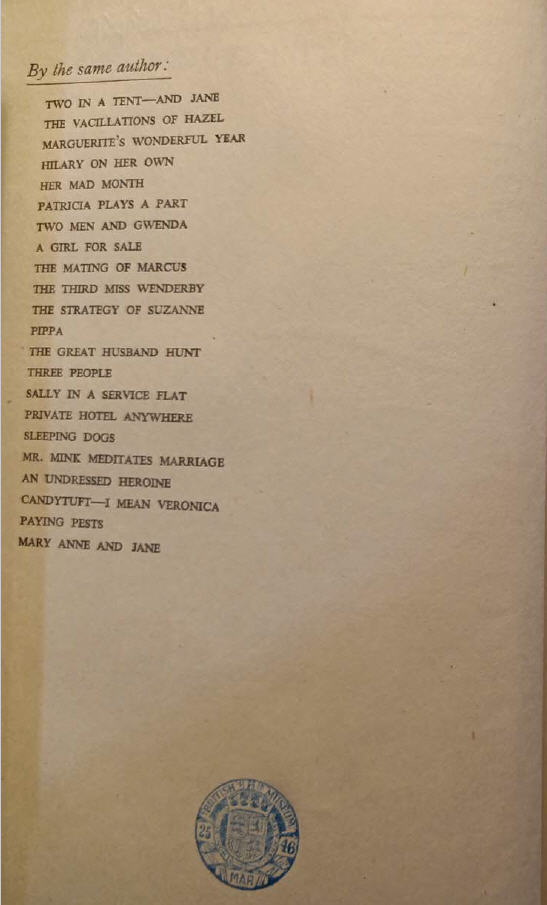
Mabel Barnes-Grundy wrote in the neighborhood of two dozen light, mostly humorous, mostly romance-themed novels between the beginning of the 20th century and 1946, when this, her final novel, appeared. And I'm ashamed to say that although many of the earlier books are out of copyright in the U.S. and readily available online, I've not read any of those, because I was so obsessed, for the past several years, with getting hold of two of her final, wartime novels—Paying Pests (1941) and The Two Miss Spreckles (1946). Of the latter a review told me it was about two middle-aged sisters in Bath taking in boarders seeking haven from the war (much to the horror of the older, stodgier sister). Of the former, I knew nothing but the obvious clue in the title and that it too was set during the war. Now, thanks to our British Library visits, I'm happy to say that I've finally read the latter and sampled the first few chapters of the former. (For anyone interested, a third MBG novel published during the war, Mary Ann and Jane (1944), is actually set in the 19th century and so was of less passionate interest, though it may well come onto my radar down the road.)

Poor Unity Speckles, the younger of the two titular sisters in The Two Miss Spreckles, has long lived in the shadow and under the authority of the imposing Euphemia, though despite this there is genuine affection between the sisters. As so often in these sorts of stories, we learn that Unity's one chance at romance—a man with the unfortunate name of Onions (jokes about the Speckles/Onion union producing shallots as offspring)—was stifled many years ago by Euphemia and their mother, and they have lived in stately, if slightly decaying, conservative glory in Bath's Royal Crescent.

Mabel must have loved that
her publisher misspelled
the title of Mary Ann and Jane

But as the novel begins, a combination of Unity's frustration with her drab existence and the poking and prodding of young Jennifer Warwick, great-niece of a friend of the family, trying to stir the sisters up to their wartime responsibilities, causes them—much against Euphemia's instincts—to make the momentous decision to take in lodgers as an alternative to evacuee children (a similar motivation to that of characters in Dorothy Lambert's
The Stolen Days, which I discussed a while back). As a result, the Misses Speckle are soon uneasily providing accommodation to the argumentative Miss Poldyke (nicknamed by neighbors "the War-horse"), the fluttery Mrs. Moorfen ("the Glow-worm"), and fashion conscious Mrs. Nimmits ("the Peacock"), each of whom present unique challenges.

When I started reading, I was a bit uncertain of the book, even after years of looking forward to it. Something about the tone didn't seem right—maybe Mabel was a bit cranky writing it (she was in her late 70s and the fatigues of war must have been wearing, so she was certainly justified)—and there was some uneasy humor on a couple of occasions—wishing glibly for people to have mood-improving stays in concentration camps, for example, to make them better appreciate their situations (at a time, surely, when MBG and her publisher should have known enough about the camps to know they weren't funny in any context). But once the scene and the characters were established, with Euphemia almost too well established as cranky and sometimes even a bit close to deranged, and the paying guests have moved in, it began to flow rather irresistibly and I had to surrender my more critical standards and just enjoy the ride. It also ultimately flirts a bit too much with sentimentality for my taste, so it's not an absolute favorite, but it was nevertheless a very pleasant wartime frolic.

Barnes-Grundy obviously had quite an interest in hotels and boarding-houses as settings. In addition to these two novels from the war, at least two earlier works, Sally in a Service Flat (1934) and Private Hotel—Anywhere (1937), would seem to have similar settings. I thought it was odd, nevertheless, that she would have used the "paying guests/pests" theme twice in her wartime novels. Reviewing the opening of Paying Pests, however, it turns out that while The Two Miss Speckles looks at the theme from the standpoint of the reluctant hosts bringing strangers into their home, Paying Pests shifts the perspective and features a young woman narrator evacuating with family members to paid quarters in quieter settings, no doubt encountering discomforts and complications living in other people's homes. It will pretty certainly be on my wish list to get hold of again should I make a return visit to the British Library…

And I do think I'll have to get round to sampling one of MBG's earlier novels now. Perhaps A Thames Camp (1902), described as "a wife's gossipy diary of outings on the Thames and at the seaside"? Hmmmm…
NOTE: The comment function on Blogger is notoriously cranky. If you're having problems, try selecting "Name/URL" or "Anonymous" from the "Comment as" drop-down (be sure to "sign" your comment, though, so I know who dropped by). Some people also find it easier using a browser like Firefox or Chrome instead of Internet Explorer.

But it can still be a pain, and if you can't get any of that to work, please email me at furrowed.middlebrow@gmail.com. I do want to hear from you!