Showing posts with label Susan Scarlett. Show all posts

Saturday, July 30, 2022

PUBLICATION DAY APPROACHETH!: Elizabeth Fair and Susan Scarlett (Noel Streatfeild) titles almost here!

By the time new titles are actually released, we've been working on them for months and I at least am already deeply enmeshed in our next batch (just wait until you hear about January!!!), but even so, the anticipation and excitement build. I'm always so eager for you all to be able to get your hands on the books and start enjoying them (hopefully) as much as I have.

Our thirteen titles being released August 1—including a "new" previously unpublished novel by one of our most popular authors, Elizabeth Fair, and 12 charming, funny, setting-rich romances from "Susan Scarlett", better known as one of the most famous children's authors of all time, Noel Streatfeild—together comprise perhaps our most buzzed-about batch ever, which only adds to my enthusiasm.

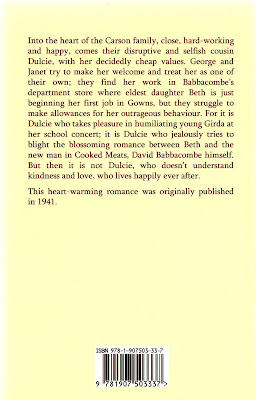
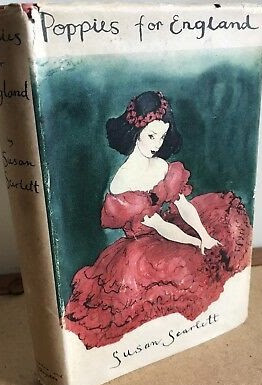
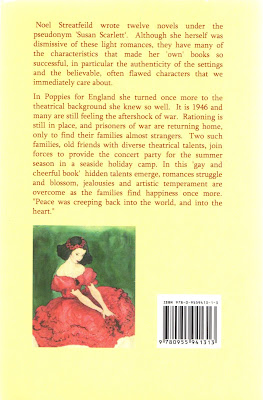
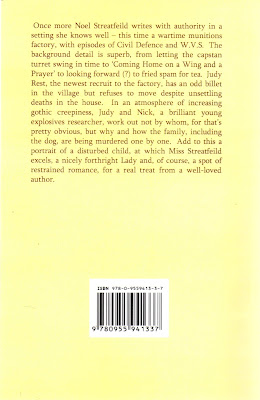
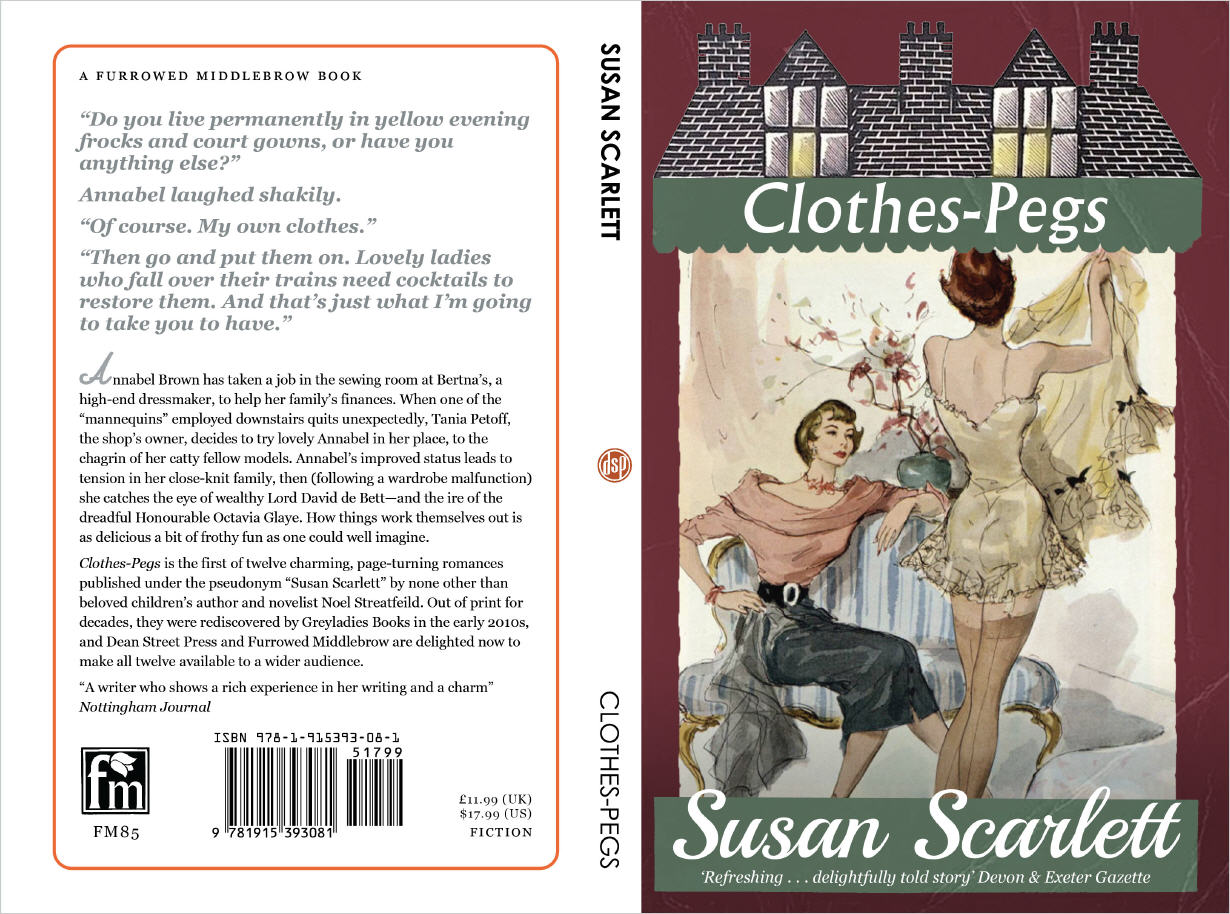
You've already seen the front covers of these new titles, but here, to further tempt and tantalize you, are the full paperback covers. Hope you like them, and hope you love the books themselves!


Friday, June 17, 2022

The Scarlett Woman, Part 5: NOEL STREATFEILD (as SUSAN SCARLETT), Ten Way Street (1940) & Sally-Ann (1939)


"This is our new governess,'' said Meggie. " She's a nice sort of governess. She called us little horrors."
"And toads," David chimed in.
Betsy stood on one leg and held the other.
"And she said we were smug and detestable little beasts."

Wrapping up, after a slight delay, my writing about the fabulous Susan Scarlett novels by Noel Streatfeild, having now announced that we're reprinting them all come August (and having the delightful luxury of using our new covers as illustrations for this post), I have two real gems to finish up with. These are mood-brighteners for sure. To start, the fourth Scarlett, Ten Way Street (1940).

Beverley Shaw, raised in an orphanage and trained to be a governess, gets her long-awaited first job working for Margot Cardew, a brilliant stage actress (and a gloriously narcissistic diva to boot, a vibe we were channeling when selecting our cover image), whose three precocious children are accustomed to being used primarily as their mother's props—photo shoots demonstrating what a lovely mother she is, charity performances showing off their adorableness, and the like. Though initially frustrated that her first job is with such pampered brats, rather than the needier children she has imagined caring for, Beverley soon realizes that Meggie, David, and Betsy are genuinely in need of her care too.

Original cover of Ten Way Street, courtesy of my Fairy Godmother

Fortunately, Beverley has advice from her friend Sarah, also a governess to an impoverished vicar's children while their mother recovers from a long illness. And she certainly needs advice to navigate between Margot's kind but exhausted secretary Winkle, her sleazy French maid Marcelle, and the handsome Peter Crewdson, whom Margot loves but who is soon taking an interest in "Joan of Arc", the spirited young governess he first meets giving the children a piece of her mind (see above).

You won't get any prizes for guessing how it all turns out, but the ride is everything, and there are some wonderful moments along the way. Beverley is likely to earn considerable points from readers for her spirited defense of the work she does when Peter appears to disrespect it:

He chuckled.

"Poor Joan of Arc. It's a hard life."

She looked up at him, flushing.

"I'm just as keen on bringing up children as you are on your biochemistry. You know all about the chemicals that make an animal. I've studied the slugs and snails and puppy dogs' tails, and the sugar and spice that make a child. It's my job and I'm going to do it well. So don't laugh at me."

You go girl! And when Beverley accompanies the children to one of their mother's performances, her first visit to a proper theatre, Streatfeild gets a chance to share her knowledge of show biz and her vivid sense of the magic it creates:

Thrilled as anybody must be who is unused to a theatre, she watched the wings fly up into the roof and the cottage front disappear and the whole stage hung in purple curtains. She watched rostrums built up and covered in purple cloth and a flight of steps put in place. Meanwhile all the actors who were to appear were streaming on to the stage.

It's really perfectly lovely and entertaining. I gulped it down. 


In fact, I loved
Ten Way Street almost as much as I loved my next Scarlett, 1939's Sally-Ann, the second of the books to appear (in book form, at least, though it had been serialized a little earlier).

The Marchioness’s face changed. “Well, that would be a way out of the difficulty.” She turned to Ann. “What is your name, dear?”

“Ann.”

“Would you mind being Sally for this one afternoon? The real Sally’s surname is Groot but you needn’t use that. Everyone will think you are Sally. They’ll probably call you Sally for they’ve all heard you were coming over for the wedding. You needn’t actually tell a lie about it. But just accept the name.”

Ann looked round the faces. Manners, Dennis, Mona, the Marchioness. They all eyed her expectantly.

“Very well, my lady.”

Charming young Ann Lane once aspired to become an analytical chemist, but when her father's business went bust and her brother Bunny developed a weak heart (heart and eye problems are an epidemic in Streatfeild's neck of the woods), she had to train to be a cosmetician. She was fortunate to find good employment at the Maison Pertinax, an elegant London hair and beauty salon originally founded by Thomas Pert (possibly killed off in the post-World War I years by the shock of women bobbing their hair). 

Ann is good at her job, and well-liked by her colleagues, who include Connie and Iris, two young women who are, as they say, no better than they ought to be, and who take full advantage of their assets to acquire more assets, but who become surprising allies for Ann despite bemoaning her naïveté; June, who fears herself a surplus woman while limiting herself to bread and butter to reduce her weight (for pete's sake, June, put down those carbs!), and the salon's manageress/receptionist, the rancid Lila Grey, known to staff as Nosey P.

On the day we first meet Ann, her superior falls ill with influenza on the day of a high society wedding at a castle near Lewes, and Ann must step in. And on a day when she's wearing her frumpiest clothes, no less! Fortunately, Lady Mona is not at all a Bridezilla and takes to Ann right away (after a temple massage that puts her into a blissful half hour nap, who could blame her?!). But then disaster strikes, in the form of a sudden "violent sickness" visited upon one of Mona's bridesmaids, a boozy girl from South Africa. Mona's Cousin Dennis (clearly flamboyantly gay, but apparently no less liked or appreciated for his abilities—points to Streatfeild there) is frantic that his elaborate plans for the wedding procession will be utterly ruined … if a replacement can't be found who can wear boozy Sally's dress.

Ann, of course, just happens to be the right size, and makes a hit at the wedding, with the result that Mona insists she shall come to the reception as well, in an elegant blue evening gown and an ermine fur (well, if she insists!). There, Ann makes a considerable impression on the best man, Sir Timothy Munster, and an equal, if rather more hostile, impression on the glamorous Cora Bolt, who grew up with Sir Timothy and has always taken for granted that he will marry her one day.

Oh what a tangled web we weave! And what fun we have along the way. This is as light and airy as a novel can come, and yet, as I've said ad nauseum about these Susan Scarlett novels, its characters are so plausible and likable (or loathable), that it couldn't matter less that it's a paint-by-numbers plot. Ann is a spirited, charming heroine, Sir Timothy witty and noble, and Lady Mona simply too good to be true. And surely I won't be the only reader who feels affection for the tarty Connie and Iris:

“That’s the trouble of being a nice girl. You get funny ideas. Marriage!”

“What is it?” said Iris. “Never heard of it.”

“It’s what girls like us come to when the bloom’s off.”

There's even a bit of late 1930s celebrity spotting when Sir Timothy takes Ann out on the town. We get singer Marie Tempest for starters, plus "This is a very literary and theatrical place. In the corner there is Dodie Smith. By the door is John Gielgud. And that’s Jessie Matthews and Sonnie Hale.” I loved the mention of Dodie Smith, at a time when she would have been known only as a playwright (her first novel appeared in 1949)—and there's a bit of an in-joke since John Gielgud and Marie Tempest were actually the stars of Smith's 1938 stage hit, Dear Octopus. Matthews and Hale, meanwhile, I had to look up—actors both, who presumably had bigger names in 1939 than they do now…

It's been such fun reading and writing about these novels that I wish Streatfeild had eschewed her "literary fiction" altogether and written about 40 more of these. (Word to the wise: do what you're good at, which in Streatfeild's case was clearly children's fiction and romance.) I realize these five posts have only covered ten of the twelve novels. Summer Pudding, as I think I mentioned before, I reviewed here way back in the dark ages. And Love in a Mist, the last of the Scarletts, from 1951, was actually the first one I read on this binge, late last year, before it had even occurred to me that we might reprint them, and I neglected to make good notes on it. Rest assured, however, that it's plot involving a spoiled child, a mother who has read too much child psychology, and a film company in search of a new child star, is (though perhaps slightly more melodramatic) just as deliciously readable as the others, with a memorably squabbling family elegantly brought to heel by a wise matriarch and the knowledge of the film industry, which Streatfeild had acquired from earlier book research, fully on display. Lights, camera, action indeed!

Now, all there is to do is wait till August when they're all available again at last.

Wednesday, April 13, 2022

SURPRISE!! (maybe?): Twelve more Furrowed Middlebrow titles from Dean Street Press, coming August 2022

A couple of weeks ago, when I absolutely played it cool and made the very restrained, understated announcement that we'd be releasing (no big deal) a previously unpublished, long-thought-lost novel from ELIZABETH FAIR in our summer batch (see here if you missed my laid-back reveal or want to relive its mellow subtleties), I mentioned that although it was taking a bit longer than usual to finalize our other summer titles, that additional announcement would be coming soon.

Well, "soon" has arrived.

And I'm certain that the announcement of these 12 new additions to our list will come as an enormous surprise to you all. It's not like I've mentioned them here and on Twitter a million times lately or anything.

Ready? Brace yourself.


That's right. Come August, we're releasing new FM editions of
NOEL STREATFEILD's 12 delightful "romances" under the pseudonym SUSAN SCARLETT, originally published 1939-1951 and subsequently out of print for decades until the brilliant Shirley Neilson at Greyladies Books rediscovered them in the early 2010s (yet another thank you I owe to Shirley for her astonishing knowledge and prescience in unearthing treasures). As many of you have pointed out in the past couple of months when I've written about the novels' charms, even those reprints, now out of print as well, have become challenging (and costly) to track down. But in August they'll finally be available again at the click of a mouse—and (lucky you) for rather less than I had to spend to get hold of them myself!

As I mentioned in my intro to the books a few months ago, Streatfeild seems to have felt considerable embarrassment over these "romances", as opposed to her sixteen other "literary" novels for adults (currently available in e-book from Bello Books). But she certainly needn't have. In these books, she promptly mastered yet another genre, the cheerful romance, and proved herself adept and irresistibly entertaining at it. The books overflow with charm and cheer, and feature marvelous detail about everything from department store detectives and holiday camp theatricals to the film industry, a wartime munitions factory, and (of course) the ballet. All accompanied by rich supporting characters, entirely believable and amusing families, and page-turning romance. Not to mention the fashion!

You may not gasp with surprise at how these novels' plots unfold, and you won't be likely to mistake them for Dostoevsky, but I can think of no better brain candy to give you a break from the bleak world news. Which, I might add, is what led me back to them a few months ago. Although all my posting and tweeting about them the past couple of months might make it seem as though I was already premeditating reprints of these, I actually had no such idea at all initially. I needed escape, remembered how much fun I'd had with a few of these when Shirley first released them, and my motive was purely medicinal. It was only after reading several and seeing how they had managed to brighten even the darkest days, that I thought perhaps some shiny new Furrowed Middlebrow editions of them might be in order. Rupert at Dean Street Press got on the trail of the rights, and voila!

However guiltily and inadvertently, Streatfeild here raised shameless, delicious escapism to the level of an art form. And come August they'll be just what the doctor ordered for your much-needed holiday from reality.

Friday, April 1, 2022

The Scarlett Woman, Part 4: NOEL STREATFEILD (as SUSAN SCARLETT), Under the Rainbow (1942) & Peter and Paul (1940)


Saltings was enchanting. If it had not been so ungetatable it would have been crammed with tourists all the summer through. A Norman church, grey and weathered, sat in a churchyard so green by comparison with the surrounding yellow-grey of the downs that, from the crest of the hills, it looked like an emerald. … To those who saw Saltings first on a hot day in summer—when heat shimmered in the hollows—that churchyard, and those sheep, and the surrounding cottages with their flaming gardens, stood for ever as a picture of peaceful England.

Well, the world is still awful, and so my escapist reading continues. Thank heavens I rediscovered these delightful books just as the world fell into an even darker crevasse than usual. And these two Susan Scarletts make a nice pairing, both featuring vicars, though in the first the vicar is the lead and in the second he's relegated to a cameo.

In Under the Rainbow, Martin Richards, a dedicated, idealistic vicar, has found himself too physically weak for life in an impoverished London neighborhood, so (poor guy) he has been moved to the most idyllic village imaginable, with a lovely home watched over by an impossibly perfect housekeeper, 60-year-old Bertha, who has raised 10 children and wants nothing more than to work her fingers to the bone for the vicar.

Naturally, something must create complications, and here it's the sudden (remarkably unmourned) death of Martin's sister and her husband in a car crash, leaving Martin to take in their children, Polly and Andrew. Martin clearly needs someone to care for the children, and he finds our heroine, Judy (Streatfeild recycling names again, this time from Murder While You Work), who is absolutely (almost tiresomely) saintly, but who has come through her share of difficulty and is determined to make a new start, so perhaps we can forgive her.

Around the same time, Martin is saddled with his ghastly Aunt Connie, who is not only conservative and jealous and petty ("she believed, sub-consciously, that a child who is at that moment contented with something must be a child who is doing the wrong thing, and must, therefore, be promptly set to do something else"), but also nearing a form of hateful lunacy, particularly in regard to poor Judy. And if that weren't enough, Lady Blacke, the widowed squire (squiress?), who fancies herself a kindly benefactor to all (as long as she doesn't have to inconvenience herself by giving anything but money) has determined that Martin should be her next husband, so she loathes Judy as well and sets about investigating her troubled past in order to rid herself of this meddlesome saint. Some additional spice is added by the local schoolmaster, who promptly falls for Judy, and his 17-year-old sister, who alarmingly sets her sights on Martin as well (I think he really must be the Anglican version of Andrew Scott from Fleabag).

It's all quite amusing, though reflecting on this book now, it seems perhaps even sillier and less plausible that many of the other Susan Scarletts. But I can honestly say that I cared not one whit when I was reading it, and because I do love an idyllic village setting, it made almost as addictive reading as, well, all the other Scarletts I've said were addictive reading.

Under the Rainbow was published in 1942, but there's nary a mention of the war, though that quote at the beginning of this post might have been meant to pack a little extra punch of meaning with its image of "peaceful England".


Next up is
Peter and Paul from 1940, also containing no glimmer of war (though there is some rather catty behavior):

It is not fun being the plain one of the family. But being the plain one of twins is a wretched position. That’s why parables about grains of mustard seed, which grew up and startled everybody by their magnificence, did Pauline good.

Petronella and Pauline Lane are 17-year-old twins, but obviously not identical ones, as "Peter" is apparently the most ravishingly beautiful young woman ever to have lived (judging from the reactions of other characters throughout), while "Paul", though appealing, is the kind of girl who gets lost in the shuffle, attention-wise. (Honestly, lucky Paul, but of course she doesn't see it that way.) Paul is also the smarter, more sensitive one, while Peter, though basically kind, is utterly self-absorbed and obsessed with Hollywood and its glamorous stars.

Their father, Mark, is the local vicar, a bit stern and traditional in his views of women ("so much of a saint that if he wasn’t a great dear he’d be a prig"), but loving and kind as well, and fortunately malleable in their mother Catherine's hands, so that she is able to arrange, against his instincts and with the help of the amusing local aristocracy in the form of Lady Bliss, for Peter and Paul to go to London to work at the dress shop run by David, the son of Lady Bliss. This so that the pair can meet eligible men, which they clearly can't in Saltings—surely even a vicar "must see as he ground his way round his parish in their deplorable old Morris, that there was not a marriageable man within miles."


David's fortune-hunting manageress Moira Renton (who also skims some of the shop's profits for herself) is anything but pleased by the arrival of the twins, though Peter, naturally seeing as how irresistible she is, becomes the muse for David's designs and slips out of Moira's control. As a friend of Moira's puts it:

“I don’t know what Moira’s game is,” she said to the table generally, “but I suspect heaven watches over anything quite as lovely and quite as stupid as that. Special guardianship, you know, like they say drunkards get.”

Paul is less lucky though. Moira lands her with the exhausting job of messenger, in an attempt to wear her out and drive her away, but Paul unexpectedly loves the job and befriends everyone on the staff. Paul also feels an immediate affinity for David, but though he is initially charmed when he meets her on her own, he is of course swept utterly off his feet by his first glimpse of Helen of Tr—er, I mean Peter. But does that way happiness lie for him? And indeed, will anyone at all find happiness if Moira has anything to do with it?

Peter and Paul is the shortest of the Susan Scarlett novels, and one of the first to be written, since though it only appeared in book form in 1940, it was apparently serialized in 1939, the same year in which Clothes-Pegs and Sally-Ann appeared. One wonders if Streatfeild was working within the confines of a word limit, as the ending, though satisfying enough, is a bit more abrupt than one would expect. But it's as light and frivolous and charming as all the other Scarletts, a worthy companion to Clothes-Pegs in its dress-shop setting, but here we get to see the shop from a different perspective, and get some entertaining glimpses of London nightlife of the time as well.

Unlike Lady Blacke in Under the Rainbow (who in any case has only married into the upper crust), Lady Bliss is the kind of aristocrat Streatfeild loved best. Her chatter while recommending a place for the girls to stay in London is a particular delight:

“And I’ve just been telling your mother I know of a perfectly charming place where you can stay, except at the week-ends, of course, when you’ll come home. I’m sure your dear father wouldn’t dream of allowing you to be away on Sundays, and quite right too. Why, I had a niece who was away every Sunday and that was why, I am sure, things turned out as they did. Sundays can be so dull, especially in the winter, and you must do something. Anyway, it was a very nice baby and they’re married now.”

I'm starting to run low on Susan Scarletts now, but I still have at least a couple left to enjoy. We all need some escape these days, and Streatfeild was a master at providing it (even if she was inexplicably reluctant in later years to admit she'd written these delightful bits of fluff).

Friday, March 18, 2022

The Scarlett Woman, Part 3: NOEL STREATFEILD (as SUSAN SCARLETT), Babbacombe's (1941) & Poppies for England (1948)


Just for a moment or two on her second day in the shop she sat down. A fellow-junior, called Jenny, gave her a horrified dig in the ribs.
"I say, get up before Mrs. Nunn or Miss Jones see you."
Beth sprang up.
"I thought we were allowed to sit. I mean I thought it was the Shop Act or something that we had to have something to sit on."
Jenny laughed.
"So they say, but it doesn't work out that way. You won't get sacked for sitting, but if you sit you'll get the sack."

For quite a while in my Susan Scarlett reading—both a decade or so ago when Greyladies first rediscovered them and more recently in my use of them to avoid reality—I resisted Babbacombe's. It has one of my least favorite plot elements—the utterly vicious, unredeemable, scheming girl who thinks herself "all that" and really should have been exposed on a hillside at birth. This was obvious even from the Greyladies blurb, and it led me to select other Scarlett titles instead. But it turns out this was a bit of a false alarm. Although there is such a character here, she is given delightfully little airtime, and her scheming is so obviously hopeless and without effect that one needn't really notice her at all.

The name of this character, however, will be quite familiar by the end of this post, as Streatfeild seems to have had a liberal recycling policy when it came to character names. Don't confuse the Dulcie of Babbacombe's with the Dulcie we'll meet in Poppies for England. But by all means do wonder if Streatfeild had at one time known someone named Dulcie and liked memorializing her every time she had a female character who was a pain in the neck.

At any rate…

Lovely young Beth Carson is just out of school and starting her first job at Babbacombe's department store, where her father has worked for donkey's years. Beth is pure as the driven snow, naturally, and always follows daddy's orders as far as knowing her place and keeping to it, but she can hardly be blamed for tripping over a charming young man's dog at the train station, can she? And how could she have helped getting trapped in an elevator with the same man a few days later, and giving him a piece of her mind about his attitudes, before learning that he just happens to be David Babbacombe, the ne'er-do-well son of the store's wealthy owner? How could she possibly have known that her careless words would inspire him to take a new lease on life? And is it her fault if he insists upon seeing her again despite her determined rejections due to knowing her place, etc.? 


Starting work at Babbacombe's at about the same time as Beth, but as a lowly elevator girl, is Beth's useless cousin Dulcie, who has just been dumped on the Carsons by her aunt who raised her and has now had quite enough of her. Dulcie is spoiled, has some of her own money, and is a cheap glamour queen who fancies herself a seductress. But fortunately for the reader, she, like the Wicked Witch of the West, has no power here except as a minor irritant.

It all unfolds just as you'd expect, and the Carsons and Babbacombes are a delight to hang around (though a threatened-blindness subplot involving Beth's brother might well seem a bit too familiar from The Man in the Dark). As obvious and silly as it all often is, somehow—and who knows how Streatfeild does it, particularly seeing as how she was clearly to some extent "phoning in" these Susan Scarlett novels—it all rings true enough to make the novel a delightful frolic, and here as in the other novels we get wonderful details, this time of the day-to-day running of a department store, including Beth's efforts as a saleswoman, a nefarious shoplifter (and the surprising methods of a store detective), the strenuous running about of a junior, and the rigorous expectations of employers of the time for their staff. Not to mention a fairly thorough run-down of appropriate tips to staff after a stay in a country house—you never know when that might come in handy!


From the department store we move, in Poppies for England, to the stage, a subject Streatfeild knows well:

This one week's holiday was all that most of the audience could get, they were free for one week from food queues, housework and even, for many hours a day, the care of their children. It was a week of absolute rest, but everybody in the audience knew that outside the camp lay the hard, difficult world of 1946.

We're in the rather provincial theatrical world of a holiday camp for families in the immediate aftermath of World War II. The Corners and the Binns are show business families who are on the verge of dire straits due to the lack of jobs and the fact that both Arthur Binns and John Corners have spent much of the past several years as POWs in Japan. But the crisis is averted when they manage to adapt a show they conceived in their prison camp (sure, why not?) for the entertainment needs of vacationing families. All summer performing in the holiday camp, and with all their meals and accommodation provided, is quite a luxury after the difficult years of the war.

Dulcie Corners (there's that name again) has been the only member of the family with steady employment, but even she has been rather in a rut in the chorus of a West End show with no hope of stardom. She's ambitious, but also, of course, a bit of a diva, and when she sets her sights on the show's pianist and composer, Tom Pollard, gets not a flicker of interest out of him, then discovers that his interests really lie with Nella Binns, a dancer with real talent but no ability to "put herself over", danger signs start flashing.

Not a great image, but fun to see
the original cover

You can more or less imagine the rest, but the main attractions here are twofold, or perhaps threefold. There's a lush array of details of wartime and postwar life. For example, there's Alice Corner's concerns that John must feel rather lost in the family's inside jokes, having been gone for several years:

It was difficult; she and the three children had such a wealth of things they shared, it was hard not to get talking and cut him out of a conversation. Silly, wartime jokes. That time Dulcie got under the table when the flying bomb hit the end of the street, and that time she had stood in a queue for two hours to buy strawberries, only to find that she was in the wrong queue and had fetched up at that peculiar chemist who had such odd things in his window that she always looked the other way when she passed, and that time when the house was blasted and they stayed for a week with the Binns, and that time when the Binns lost their windows and part of the roof and stayed nearly four months with them.

Even the song which becomes the hit of the show and gives the book its title is inspired by the war: "An airman had told him that the crimson streak of poppies was one of the loveliest things he knew coming home from a bomb raid."

Then, of course, there's wonderful details of the problems and perils of putting on a stage show, obviously grounded in Streatfeild's exact knowledge of that life. Just little details that she must have added by instinct shine with the ring of truth, as when Muriel Binns, who has added some pounds due to the stresses of wartime (oh, how I can relate), worries about her figure and the subtleties of an audience's reactions—"An out-and-out laugh she could stand, but never a snigger." 


And finally, family stories are of course one of Streatfeild's best strengths as well, and the dynamics between the Binns and the Corners are completely charming. The Dulcie we meet this time is merely difficult and ambitious, not inhuman like the one in Babbacombe's, and the only really unfortunate element of this novel appears on the final page, with a rather unfortunate final line of "romantic" dialogue which might be seen as misogyny even though it's clearly intended as both humorous and loving. Some readers may find it jarring, others probably won't notice, but although I take it in the spirit it was intended, I rather wish it were worded a bit differently.

Similarly in terms of language, there's some unintentional irony in Dulcie's early comments on Tom's inexplicable lack of response to her charms: "Nobody can be like that really, can they? I mean, all men like women in the end, don't they, like all girls grow up to like boys?" And later: "I don't believe it's queer of me. I believe it's Tom that's queer."

Probably best if I refrain from comment…

Friday, February 25, 2022

The Scarlett Woman, Part 2: NOEL STREATFEILD (as SUSAN SCARLETT), Murder While You Work (1944) & Pirouette (1948)

My lovely Greyladies edition of Murder

Judy sat staring out of the railway carriage window. Of course there was a war on, but could any train that was trying at all really dawdle the way this one was doing?

Now that I've got started reading and writing about Susan Scarlett (see here), I find that I can't stop, and in light of world events in the past few days it seems wise not to stop.

I read these two recently in a continuing desire to avoid any contact with reality. If I wouldn't say that these two are quite as good overall as Clothes-Pegs and The Man in the Dark, which I wrote about last time, they were still marvelously effective at getting my mind off the news.

Murder While You Work is one of two Susan Scarletts that are explicitly set during wartime (along with Summer Pudding, which I wrote about here ages ago). It's also Streatfeild's one attempt (to my knowledge) at a more or less straightforward murder mystery. So it might seem odd to say that this might have been the perfect Susan Scarlett novel if not for the damned murders, but that is indeed how I felt about it. 

Our heroine, Judy Rest, arrives in the village of Pinlock to take up her new work in a munitions factory. On the train, she makes the acquaintance of Nick Parsons when he rescues her dropped lipstick (quite valuable under wartime circumstances), who, it turns out after the two engage in some extremely careless talk, is also engaged in top secret work at the same factory. Nick, the only surviving son of the formidable Lady Parsons, whom we shall meet and come to love later on ("I was the child who was too delicate to live. And now look at the damn thing. The sole survivor."), warns Judy that he's heard disturbing things about her new billet, wherein a suspicious death has recently occurred. Da-da-da-DUM.

Judy is admirably unflappable, however (if a complete dolt when it comes to romance, as we shall see), and becomes fond of elderly, recently-widowed (in peculiar circumstances) Mrs. Former and her daughter Rose, though distinctly less fond of Clara Roal, Mrs. Former's niece, who is angry and disgruntled and more than a bit shady. Clara's son Desmond is a problem too, an eight-year-old with developmental or mental health issues that manifest in his apparently nonsensical speech and tendency toward cruelty. 

And then more murders occur. Unfortunately.

Judy is charming and intelligent and capable (except in regard to love, but that works itself out, of course), Nick is witty and brave and appropriately admires Judy for her capacities as well as her looks, and the wartime setting allows Streatfeild to pack the book with fascinating detail from her own experiences. All of that I loved, and to use my favorite expression for this type of reading, the pages turned themselves. I devoured it as readily as I am capable of inhaling a tub of cookies and cream ice cream, and I assure you that my capabilities in that area are impressive.

What, then, could possibly be wrong? It's just that the murder plot is purely an annoying interruption of an otherwise entertaining frolic. It's perfectly obvious from the beginning who the murderer is, it's the why and how that are (slightly) mysterious, and the victims are (breaking the golden rule of cozy mysteries) likable and harmless. One victim we only hear of, as he is dead when the novel opens, but the next is a sweet, charming supporting character that we have grown to like. Not to mention a dog… [cringe emoji]

If only instead of a boring murderer there might have been just an annoying person that Judy and Nick had to maneuver around. One gets the sense Streatfeild wanted to show off her knowledge of psychological issues by portraying a psychopath, but I could have lived without that display. There's also Desmond, whose portrayal is perhaps accurate from a psychological standpoint but is quite insensitive by today's standards (including a single use of the "r" word, along with various other only slightly less grating descriptions). His behavior is monstrous, but one can quite see how he got there and feel sad for his grotesque neglect.

Those reservations aside, however, the novel is an absolute delight. Nick's plucky mother, Lady Parsons, in herself makes up for most of the negatives, as for example in discussing her faithful housekeeper's fortunate age:

Dibble was my personal maid before the war, but now she does everything. Up till the war was declared Dibble went on from year to year being thirty-nine, and then suddenly, when registration started, she came to me one morning and laid her birth certificate on my desk and there she was fifty-two. Of course I said nothing about the thirty-nine, I was too thankful. I just said, 'Isn't that splendid, Dibble!' and she said, 'Yes, my lady,' and we've never mentioned it since."

The tidbits and interactions in the munitions factory are also a delight, as when Judy is instructed about maintaining the proper rhythm with her lathe ("The girls in this group say that 'White Christmas' just swings it nicely"). So while the unfortunate murders may keep this from being my favorite Susan Scarlett, it still lands fairly high up in the pile.

Next up:
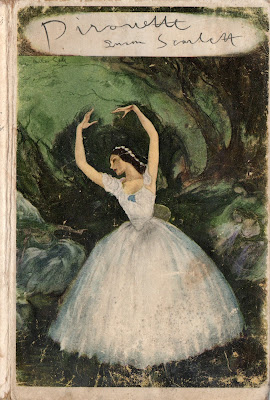
The rather lush original cover (never
mind the mildew stains)

"I've been watching you. Ever since you came to my school I've said to myself, 'There's something in that child which one day may, if she works, flower.' I'm now going to give you a chance to show the world what you can do. When I give a chance to one of my dancers I'm giving into their hands my reputation and the reputation of my school and of my ballet. Dancing is not, as with some of the other arts, a matter of short inspiration and quick effects; dancing is a vocation. A girl whom I choose to star as much gives her life to dancing as a novice entering a nunnery gives her life to religion."

Pirouette might land a little further down the pile for me—it's beginning to seem to me that the later Susan Scarlett novels have more angst and less cheerful energy than the early ones—and its focus on an 18-year-old ballet dancer on the cusp of stardom gives it a bit more of a feel of Streatfeild's children's books too, though it does contain a more or less effective romantic element. But of course center stage here is the ballet interest, and Streatfeild's intricate knowledge of a ballet company and of the dreams and frustrations of young dancers (and of the tyrannical instructors and directors who threaten to derail their lives). That's what makes this a page-turner despite it's unremarkable leading lady.

Judith Nell has been working and striving for success all her life, though this proves to have been as much due to her mother's own frustrated ambitions and her ceaseless pressure on Judith as to Judith's own wishes. Love in the Mist, the final Susan Scarlett novel, which I haven't yet reviewed, has a silly, misguided mother, no doubt, but Pirouette has one that should be promptly smothered with a pillow. Streatfeild's interest in obsessive and problematic personalities sometimes leads her to create exaggerated caricatures instead of characters, and Olive is a mother only a, er, masochist could love. Obsessed with Judith's success in a field she aspired to, Olive is at the point of completely ignoring her other children—Peter, having difficulty adjusting to life after serving in the war, and young Tim, in danger of getting involved in a gang because he feels neglected, not to mention her husband John, who has humored her in her obsessive attention to Judith but is now reaching the end of his rope. 
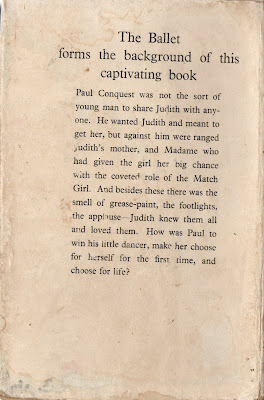
Original back cover

Of course, Judith falls in love with Paul, the brother of a fellow dancer, who is heading off to a good job in Rhodesia in a few months and wants to take her with him—just as she gets her big break in a starring role.

Some readers will cringe a bit at the book's ultimate attitude on the question of career vs. marriage and children, but of course no one can fairly expect radical political attitudes from a romance novel (though, expected or not, they have been known to creep in). As Paul sees it, "It was a damn' silly life, the ballet, sure to let her down in the end. Nobody wanted a wife with a career; it would be a far better thing if she could be persuaded to throw the whole thing up." And the irony of her father saying that Judith must make up her own mind about things as he advises Paul how to manipulate her is worthy of a cynical laugh.

But despite that, the tale has some irresistible elements. There's a delightful scene in which Prudence and Olga, two of the ballet company's stars, are deliciously catty to each other in a restaurant in front of their respective romantic interests. And one can't help but wonder if Streatfeild is making use of personal experience in the scene in which young Nadia, Paul's sister, having trained all her life for stardom but now heartbreakingly grown too tall, gives Madame Tania a brilliant telling-off that she won't soon forget. Those moments are well worth the bits of handwringing between Judith and Paul and Olive, and a plot that one can see coming a mile off.

Since I now have all the Susan Scarlett books waiting patiently on my shelves, and since the world news sure as hell isn't getting any better, I imagine I'll be reading more of them soon. Here's hoping they're all as entertaining as the ones I've read, even if none of them are likely to astonish me with their plot twists!

NOTE: The comment function on Blogger is notoriously cranky. If you're having problems, try selecting "Name/URL" or "Anonymous" from the "Comment as" drop-down (be sure to "sign" your comment, though, so I know who dropped by). Some people also find it easier using a browser like Firefox or Chrome instead of Internet Explorer.

But it can still be a pain, and if you can't get any of that to work, please email me at furrowed.middlebrow@gmail.com. I do want to hear from you!