Showing posts with label D. E. Stevenson. Show all posts

Friday, July 11, 2025

A genuine thank you, and the news!

I really can't thank you all enough for all the encouraging words and reassurance in your comments on my last post. It's pretty inspiring to be told, "Write about whatever you want and we'll enjoy it." It's unlikely that I'll take up trigonometry or the mechanics of nuclear fission as my next obsession, so you can feel reassured about that, but you've given me some ideas about directions I might take with the blog. I really appreciate your support.

On a brief reading note, I finished Eça de Quieroz' The Maias and really loved it. Part soap opera (with an incest theme no less!), part a mockery of Romanticism and noble feelings, it's entirely entertaining and has a perfect, melancholy but funny ending. Do have a look at it if you're at all into sprawling 19th-century dramas, and give Portugal's native son a bit more of the attention he deserves.

One other quick note before The News. Several people have asked me about my 2024 Furrowed Middlebrow Dozen, the dozen that wasn't (as it were). Actually, I confess that even in the midst of my dervish-like mental spinning around the holidays, I did manage to make some preliminary notes toward my Dozen, but then I got derailed and overwhelmed and it never went further. I'm going to go back to those notes and see what I can come up with. A 2024 highlights post may not be the most timely or relevant thing you'll read in July of 2025, but I enjoyed some wonderful books last year and should share them with you. Stay tuned for that (I'm not going to promise a definite timeline, as I know myself too well, but it will happen...).

Now, for news about new FM titles!

There's still a bit of time to prepare yourselves, as we're anticipating a late summer/early autumn 2026 rollout for the new books. But it will be worth the wait, as we'll have SIX new titles being released then, and they'll be from two "fan favorite" authors who are already members of the FM family.

I've long wanted to get back to DOROTHY LAMBERT after we published the wonderful Much Dithering back in 2020 (time doth flit!). She tends to be a wildly uneven author (and, unlike Mae West, when she's bad she's really NOT better), but there are some real gems among her ouevre, and we've selected four of them for release. You know that one of these has to be All I Desire (1936), which I raved about here, and which I might like even better than Dithering (!!). Also from 1936, we'll reprint the delightful Scotch Mist, reviewed here. From Lambert's World War II novels, which are, alas, quite variable in quality, we're plucking the treasure, Staying Put (1941), which, as I noted here, may not be her most polished novel but perhaps contains the single funniest scene she ever wrote, when the villagers engage in some spy-catching... And last but certainly not least, we'll also sample Lambert's post-war novels, with 1950's Harvest Home, which involves a set of eccentric Londoners being roped in to help with the harvest on a family farm.

And then, we're returning to one of our favorite FM authors for two more titles. I don't want to suggest that any kind of devious readerly conspiracy has been going on. Perhaps it was mere coincidence that several people emailed us about the same two books. (Really, I'm the first to understand that needs must when it comes to getting hold of the books one wants). At any rate, several years after Rupert and I announced, following the release of our last batch of D. E. STEVENSON titles, that we were finished with DES, some of you have sought to make it quite clear that DES is, in fact, not finished with us, so we are adding two more of her titles, Bel Lamington (1961) and its sequel Fletchers End (1962), to our paperback-only repertoire. As with several titles in our last big batch of DES, these two are already available in e-book from "another publisher," and so Dean Street Press will only be releasing a paperback version.

Some lovely person uploaded the original covers of these two novels to Amazon, and I couldn't resist swiping them and showing them to you here.


They're by illustrator deluxe John O'Hara Cosgrave, who did many of DES's covers, and they are delightful, but sadly they are still under copyright and not available for us to re-use. However, we have ideas of our own for the covers...

I hope you're as excited about these new titles as we are!

Thank you all again for your lovely comments last time. Do you know, it had completely slipped my mind that several of Elizabeth Cadell's novels are set in Portugal?! Are there other novels set here that I should know about or have my sluggish brain jogged to remember?

Monday, January 3, 2022

THEY'RE HERE!: 11 new D. E. Stevenson titles from Dean Street Press

Today's the day at last! Our eleven new D. E. Stevenson reprints, some of them previously very hard to find indeed, are officially released today. It's always so exciting when the months of effort come to fruition and new books are finally available for all. I hope you enjoy them as much as I do. Some of my all time favorites are included here.

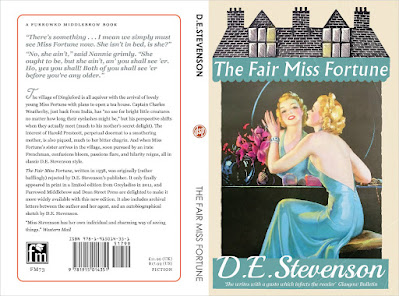
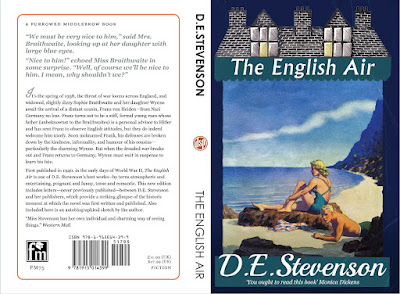
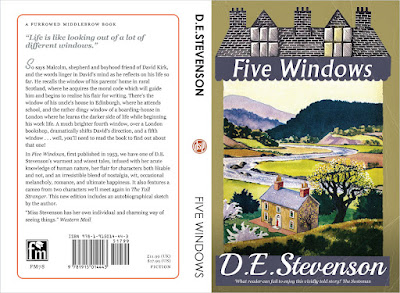
Each of our reprints includes an autobiographical essay from 1950 by Stevenson, originally written as promotional material for her novel Music in the Hills (also available from Dean Street Press), and there are additional extras included in our reprints of The Fair Miss Fortune (correspondence between DES and her agent regarding the initial rejection of the novel by her publishers), The English Air (previously unpublished correspondence between DES and publishers, which provide a glimpse of the historic moment at which the novel was completed), and Five Windows (a very short piece by DES about the writing of the novel).

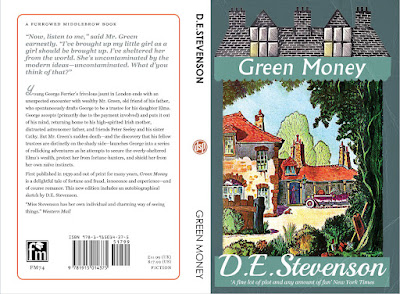
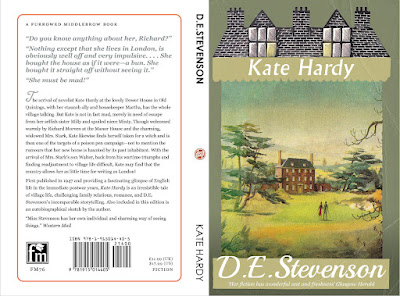
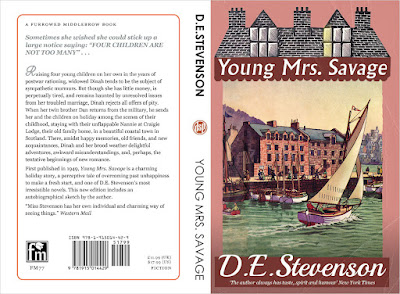
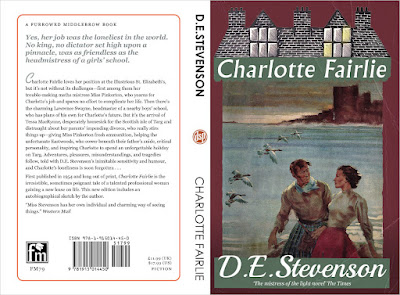
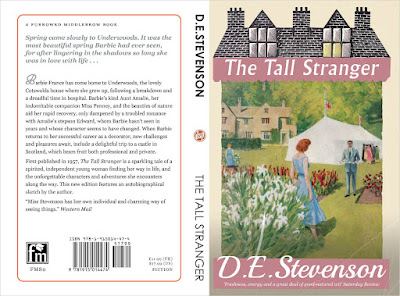
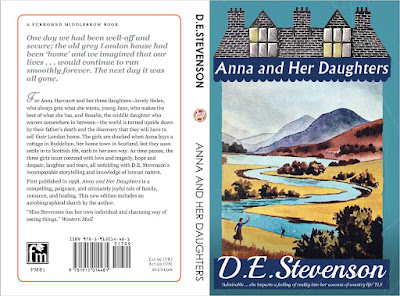
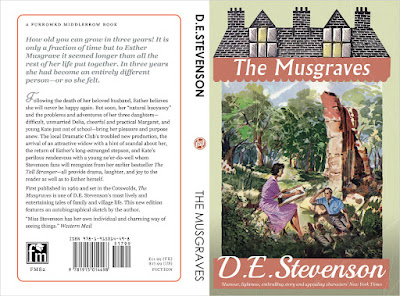
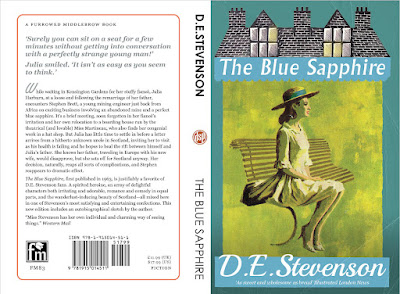
Our full covers are shown below, all making use of the books' original vintage covers (except for Fair Miss Fortune, which was never published at all until 2011). Also, a reminder that six of these are being released in both paperback and e-book, while the remaining five are being released only in paperback (e-book versions of those five are already available from another publisher). Details noted under the images below.

Enjoy!

The Fair Miss Fortune (1938)
paperback and e-book

Green Money (1939)
paperback and e-book

The English Air (1940)
paperback only

Kate Hardy (1947)
paperback and e-book

Young Mrs. Savage (1948)
paperback and e-book

Five Windows (1953)
paperback only

Charlotte Fairlie (1954)
paperback and e-book

The Tall Stranger (1957)
paperback only

Anna and Her Daughters (1958)
paperback only

The Musgraves (1960)
paperback and e-book

The Blue Sapphire (1963)
paperback only


Friday, August 20, 2021

COVER REVEAL: New D. E. Stevenson titles coming January 2022 from Dean Street Press

As those of you who have been paying attention will know, I've already announced (see here if you haven't been paying attention) that come January 2022 there will be eleven new Furrowed Middlebrow/Dean Street Press editions of D. E. Stevenson titles, many of them among her hardest-to-find and most-loved books. I said at that time that we hoped to use many of the original covers for our editions, and now it's time to show you what we've come up with. (Those of you on Twitter may already have seen these previewed there but this is the first time they've all been shown together.)

Are you ready? Brace yourselves!


All but one have original covers (though in a couple of cases we went with U.S. first edition covers rather than U.K. firsts). As a reminder, our editions of The English Air, Five Windows, The Tall Stranger, Anna and Her Daughters, and The Blue Sapphire will be paperback-only, as e-book editions for those are already available from another publisher. We will release the remaining titles in both paperback and e-book, as per our norm.

Big thanks, as so often before, to Jerri Chase for providing scans of the covers of her copies of Green Money and Five Windows!


And, last but certainly not least, we have the one title that couldn't make use of an original vintage cover image, for the simply reason that it wasn't ever published until the lovely Greyladies Books did it a few years back. I had excellent good luck with The Fair Miss Fortune, as I'd only just begun looking for possible cover images when I came across a vintage advertising image that, in my opinion, perfectly captures the frolicsome tone of the book and subtly suggests its theme and the cause of all the rollicking confusion in the plot.


I hope you're well pleased with these. We'll also have some news about exciting bonus materials to be included in these new editions. Coming soon!

Friday, May 21, 2021

Not as easy as you think: D. E. STEVENSON, The Blue Sapphire (1963)


'Surely you can sit on a seat for a few minutes without getting into conversation with a perfectly strange young man!'
Julia smiled. 'It isn't as easy as you seem to think.'

Continuing my recent reading of some lesser-known D. E. Stevenson novels, I turned to this gem (get it?).

Julia Harburn is a somewhat sheltered young woman at a loose end following the remarriage of her chilly, distant father and her own redundancy in the couple's home. She has never been close to her father, who desperately wanted her to be a boy and whose somber reserve she thinks of as his "big brown blanket": "He was wrapped up so tightly in his big brown blanket that the real man was invisible; he seldom spoke, quite often he did not hear what was said to him." She has therefore resolved to rent a room and find a job, though the details of the latter remain vague in her mind.

As the novel opens, Julia is heading to Kensington Gardens to meet her fiancé Morland Beverley, whose stuffiness and bossiness perfectly fit his name. Morland is also a chilly man, very much her father's type, and their chilly engagement has dragged on as they wait—very practically if not very romantically—for him to make partner in his law firm. While waiting for him on a park bench, Julia encounters Stephen Brett, a young man who works as a mining engineer in Africa, who is in London on some exciting business involving an abandoned mine and the perfect blue sapphire of the novel's title.


Julia finds her room, in a boarding house "quite near Kensington High Street" belonging to the theatrical Miss May Martineau (real name Eliza Potts), a classic DES woman-of-a-certain-age-with-a-heart-of-gold. And May in turn finds her a job in a hat shop with her friend Madame Claire, and memorably demonstrates to Julia the art of selling hats:

with that she leapt from her chair, seized an antimacassar, twisted it into a sort of turban and crossing the room to a gilt-framed mirror arranged it carefully upon her head. Then she turned, and suddenly she was a different person, languid and affected.

'The very latest from Paris,' she drawled, bending her head from one side to the other and patting her curls with the tips of her fingers. 'So chic, so becoming ... the line so original, so intriguing! Let us see if it becomes Madame,' she added, removing it from her own head and settling it carefully upon Julia's. 'Beautiful!' she cried in sudden ecstasy. 'What could be better? It is Madame's colour; it enhances the loveliness of Madame's eyes ; it shows off her delicious complexion! Let me pull it this way a trifle—no, that way! Exquisite!' cried Miss Martineau, clasping her hands and rolling her eyes.

But just as Julia is settling happily into her new life, she receives an unexpected letter from Randal Harburn, a hitherto unknown uncle in Scotland, who writes out of the blue asking her to visit as his health is failing and he hopes to heal the rift between himself and Julia's father. Her father is traveling in Europe with his new wife, and she knows he would dislike such a trip—as does Morland, of course—but she cannot refuse an ill man's request. Her decision, naturally, reaps all sorts of complications


As in so many D. E. Stevenson novels, a journey to Scotland transforms our heroine's life (though she has already begun the transformation process in London under her own steam), and in many ways Julia herself is transformed, as well as released her from her melancholy past. It's a story DES has told before, but she tells it so well that readers are unlikely to care if it feels familiar. And Julia's development is so convincingly detailed, and she so likeable and spirited and sincere, that it would be curmudgeonly to make too much of the fact that I wanted much more of the delightful Miss Martineau, who surely deserved a novel all her own.

One thing that struck me looking back at the opening scene in Kensington Gardens was how unexpectedly relevant it is to conversations happening today. Although it's largely played for laughs, as in the quote I used to open this post, there is something eerily familiar and disturbing about Julia's experience while waiting for the unpunctual Morland:

Julia herself was greeting the sunshine in a simple white frock and large straw hat with a sapphire-blue ribbon round the crown (it so happened that the ribbon matched her eyes; perhaps she was aware of this fortunate circumstance). She had dressed to please Morland, of course, but soon she became aware that quite a number of people were taking pleasure in her appearance. In fact it began to be rather uncomfortable sitting here all by herself . . . she wished Morland would come.

An old gentleman stopped and stared at her …. He stopped and stared and made a movement as if he intended to sit down beside Julia on the seat; but she returned his stare in such a forbidding manner that he changed his mind and walked on.

Three youths who were strolling along arm-in-arm looked at her hopefully, but Julia took no notice so they nudged each other and giggled and left her in peace.

It's a striking thing for an author like D. E. Stevenson to have delineated so clearly—the fact that a young woman alone in public must always be on the defensive, must be prepared to stare in a forbidding manner to avoid harassment, and must always be alert to what's happening around her in case it leads to danger.

Who says middlebrow fiction isn't political and doesn't speak to relevant issues?

Wednesday, March 17, 2021

Coming back to life with D. E. Stevenson

Well now. This has been considerably more of a blog break than I originally planned. Apologies for that, and for depriving myself of the lovely feedback, support and inspiration I get from your comments.

I think I mentioned that right in the midst of my planned break of a couple of months, my colleague went out unexpectedly on what turned into a three and a half month medical leave. As our team (dealing with the legal side of child dependency cases) was not only deemed essential, but sadly saw a considerable increase in cases in the past year due to the added stress of covid and its related lockdowns, financial impacts, school closures, etc., this made for a quite intense few months for me. I was generally working from home three days a week, fortunately, which made all the extra work a bit more manageable (no commute time really does make quite a difference), but though I actually did quite a lot of reading, I was largely reading for sanity and survival and had no bandwidth left for sharing my thoughts (not that they would have tended to be worth sharing under the circumstances), nor did the idea of sitting at a computer to write blog posts seem enticing after spending far too much time every day in front of a computer anyway. The best I could do many nights was to sit with Andy watching TV or a movie, and then pass into a coma by 10:00 at the latest.

I wrote a very little bit about the reading I did late last year in my FM Dozen post after Christmas, but it wasn’t until a bit after that that I found myself, after too long an absence, once more reading that most revivifying of all authors—D. E. Stevenson, of course—and felt just the beginnings of an urge to rejoin the outside world. Around the same time, I started puttering with research on the 300+ new authors I’ve come across for my list since my last update there 30 or 40 years ago (or perhaps not quite that long, but it feels like it). Progress is slow, but that anything at all has been happening is encouraging, and I’ve already come across a couple of intriguing authors to explore (and added a couple of new books to my TBR shelves), which is always a source of inspiration to keep going with it…

But back to DES. Somehow I had reached the faulty conclusion that I had already read most of her best work, and what remained was only to be resorted to in case of dire need. There are the marvelous Miss Buncle books, of course, and the four Mrs Tim diaries, and other highlights like Spring Magic, The English Air, The Baker’s Daughter, and the Vittoria Cottage trilogy. Other quite good titles too. But I had been assuming that most of the rest were DES in “romance” or melodrama mode (or worse, in sci-fi or spy novel mode—though it's true that all of those efforts have their defenders, and in a pinch I’ll take any of them). Most importantly, I feared that they would lack her irresistible humor and playful charm.

A comment to that effect in an email to Jerri Chase—one of the world’s leading experts on DES—led to her setting me straight. (And whether or not that particular correspondence with Jerri had anything to do with any possibility that Dean Street Press might publish some of the remaining out-of-print DES titles is something I of course couldn’t possibly comment on at this juncture…) Ahem. But since Jerri was the one who had urged me to read Spring Magic when it was still languishing out of print and unappreciated, and since that book immediately became one of my favorites (and a popular reprint for DSP), I tend to listen to her recommendations…

My "little splurge"

So, I had a little splurge on Abe Books (using the term “little” quite loosely). DES’s books, especially the ones still out-of-print, are not cheap, and I’m really not a fan of the cheap Fontana or Collins paperback editions with their (often) ghastly, inappropriate covers. Factor in that some of these (and even some later hardcover editions) are abridged or otherwise edited from DES’s intent (see here for the definitive site by Susan Daly, another of the world experts on DES, with anything you could possibly want to know about her books, including the mistreatment they’ve received at the hands of other publishers), not to mention my fondness for intact dustjackets, and it was a foregone conclusion that I’d be finishing up my Christmas gift cards (and then some) in no time.


I began my DES renaissance with Young Mrs Savage, a 1949 title which combines immediate postwar concerns with a holiday story perfectly calibrated to soothe my COVID-deprived wanderlust. Dinah Savage is a young widowed mother of four who steadfastly rejects all offers of sympathy for her state but is nevertheless having trouble making ends meet, is tired all the time (aren’t we all these days?), and remains haunted by unresolved issues from her troubled marriage. Although I can’t claim that my distinctly benign winter stresses compare to those of Dinah’s, they were sufficient for me to be living vicariously through her when her twin brother Dan returns from the military, decides she simply must have a holiday (again, why does no one ever decide this about me?), and sends her to stay with their unflappable Nannie at Craigie Lodge, in a beautiful coastal town in Scotland.

No one who knows D. E. Stevenson’s work will have trouble fleshing out the events of the novel—old friends, new acquaintances, awkward misunderstandings, and perhaps the tentative beginnings of a new lease on life. But that makes it no less delightful to read, and DES has real insight into how one can overcome past unhappiness to make a fresh start. It was just what I needed at a challenging time, and it’s one to hold in store for a re-read when I again need some uplift.

From there, I moved to what I feared was dangerously late in DES's career (her final novels not being, by most counts, among her best). The Musgraves was published in 1960, and I feared melodrama or tormented love, but instead got an absolutely irresistible family story—set in the Cotswolds, no less, so just as satisfying, wanderlust-wise, as coastal Scotland.


Following the death of her beloved husband, Esther Musgrave believes she will never be happy again. But soon, her "natural buoyancy" and the problems and adventures of her three daughters—difficult, unmarried Delia, cheerful and practical Margaret, and young Kate just out of school—bring her pleasure and purpose anew. DES clearly has a liking for widows as heroines, and Esther, like Diana Savage, provides her with ample opportunity to show a woman (this time approaching middle age) beginning to re-embrace life after loss. There's the local Dramatic Club's troubled new production, the arrival of an attractive widow with a hint of scandal about her, and the return of Esther's long-estranged stepson.

Plus, although I didn't know it yet while reading, there's also a character here who recurs from The Tall Stranger, published three years earlier, a character readers may not be exactly happy to meet again, but whose appearance certainly adds some zest. (No spoilers!)

The story rollicks along in classic DES style, and I ate it up like candy. You know how much I love village stories, and this turned out to be an excellent one. Before moving on, though, I have to introduce the Bloggses, local residents, and provide a glimpse of their unique way of generously sharing their newest acquisition: 

Soon after the arrival of Puggy the Bloggses bought a 'telly'; (it was essential to have one, because all their neighbours had 'tellies') but none of them liked it much. The fact was they were all great talkers and they found it more interesting to exchange news of their daily doings and the gossip of Shepherdsford than to look at and listen to the daily doings of the outside world, and they soon discovered that it was more comfortable to sit and talk quietly than to shout and bellow at each other with the 'telly' turned on full blast. Of course they turned it on full blast when a neighbour dropped in to see them because that was the right thing to do, but neighbours often brought news—interesting news about other neighbours—which the Bloggses wanted to hear. 

"I dunno why we got the danged thing," declared Mr. Bloggs one evening when the 'telly' had been particularly troublesome. "I couldn't scarcely 'ear a word Danks was saying. It's just a nuisance, that's what." 

"I couldn't 'ear Mrs. Danks neither," said Mrs. Bloggs with a sigh. 

"We can turn it off now they've gone," said Flo, suiting the action to the word.

The Bloggses provided me a much-needed chuckle in all the craziness.

Immediately after, it happened that I turned to The Tall Stranger, not realizing the connection with The Musgraves. No need at all to read the two novels in any order--there is merely an overlap of one fairly significant character and mentions of a few others.


In The Tall Stranger (1957), we are introduced to Barbie France, who, following a sort of breakdown and a dreadful time in hospital in London, comes home to Underwoods, the lovely house in the Cotswolds where she grew up. Barbie's kind Aunt Amalie, her indomitable companion Miss Penney, and the beauties of nature aid her rapid recovery, only dampened by a troubled romance with Amalie's stepson Edward, a childhood friend Barbie hasn't seen in years and whose character seems to have changed in the intervening time.

When Barbie eventually returns to her successful career as a decorator, new challenges and pleasures await, include a delightful trip to a castle in Scotland, which bears fruit both professional and private, though difficulties with Edward have a way of persisting. Naturally, all works out for the best, and I couldn't stop reading this one either. It has very nearly the sparkle and spirit of a Miss Buncle or Spring Magic, and will certainly belong on a re-read list, too, whenever I need some inspiration or just a fantasy trip to the Cotswolds and Scotland!

I didn't take good notes on any of these, because I was only treading water at the time and my thoughts might not have borne repeating, but suffice it to say I loved all three of these "lesser-known" DES novels, and I owe a debt of gratitude (yet again) to the glorious D. E. Stevenson for providing some much needed literary therapy and making me feel like part of the real world again. Thanks also to Jerri for recommending these titles. And as you can see from the photo above, I have quite a few more to getting on with…

I should mention that my work colleague returned to work at the beginning of March, which is why I'm reasonably coherent and capable of writing this post. Not only that, but I'm taking a vacation next week to stay at home, read books, do research, get some exercise, and indulge in a couple of afternoon naps. So you might actually start hearing from me again more than every three months!

Friday, September 13, 2019

AN ANNOUNCEMENT: Eight more Furrowed Middlebrow/Dean Street Press titles, coming January 2020


It's that time again!


No theme this time around—just eight stellar new reprints, by three marvelous authors, due for release from Furrowed Middlebrow and Dean Street Press in January of 2020. This will bring us to 46 titles in all, enough to fill an entire shelf of my—er, I mean, your bookcase!

First up is an old favorite, by which I mean both an author that we've published before and an author who helped inspire my passion for British women writers in the first place. 


We've already published five of the very best titles from D. E. STEVENSON, and in January we'll add three more. Not exactly a trilogy, but featuring overlapping characters from the Dering family, Vittoria Cottage (1949), Music in the Halls (1950), and Winter and Rough Weather (1951) are fan favorites and wonderful tales of postwar life in England and Scotland. 


(NOTE: Winter and Rough Weather has previously been reprinted and released in e-book as Shoulder the Sky. Although there is some evidence that the latter was actually DES's preferred title, DES's granddaughter specifically requested that we use the former for our edition and we have honored her wishes.)


Next up, I'm really thrilled to add another much-beloved and widely-known author to our list. Many of you already know DORA SAINT (better known by her pseudonym, Miss Read) as the author of two bestselling series, the Thrush Green and Fairacre books. 


But last May I wrote about coming across a lesser-known Miss Read treasure (see here). Fresh from the Country (1960) was such a delight, I couldn't believe the rights wouldn't already have been snatched up by some savvy publisher. Happily for me, however, I get to be that savvy publisher!


And finally, you had to know it would be on my mind: Having used the "buried treasure" heading for only (if my count is correct) three reviews on this blog, and having already published the books reviewed in two of those posts, hmmmm, perhaps the third one will be coming around soon?


Yep, I'm over the moon that we'll be able to publish four absolutely brilliant novels by DORIS LANGLEY MOORE, who may be the most famous person ever to be a horribly neglected author. 


I reviewed the novels here and here, fell head over heels in love with them, and now A Game of Snakes and Ladders (1938, 1955), Not at Home (1948), All Done by Kindness (1951), and My Caravaggio Style (1959) all join the Furrowed Middlebrow "books in print". Smart, funny, gorgeously plotted, and delightfully unpredictable, they deserve to be classics but have been neglected for half a century. No more!

And that's that for January. Not too bad, eh? I should be able to share the new covers here before long, as well as information on intros. And work is already going on furiously behind the scenes (i.e. very often while sprawled on the sofa or lounging in bed) to start pulling together Batch 6…
NOTE: The comment function on Blogger is notoriously cranky. If you're having problems, try selecting "Name/URL" or "Anonymous" from the "Comment as" drop-down (be sure to "sign" your comment, though, so I know who dropped by). Some people also find it easier using a browser like Firefox or Chrome instead of Internet Explorer.

But it can still be a pain, and if you can't get any of that to work, please email me at furrowed.middlebrow@gmail.com. I do want to hear from you!