Showing posts with label Monica Stirling. Show all posts

Friday, December 10, 2021

"[S]he was behaving towards him as a man does to a mistress": MONICA STIRLING, Some Darling Folly (1955) & Adventurers Please Abstain (1952)


"There's never anything for me to be obstinate about where my husband's concerned."
 
She seemed to expect Remy to share her pleasure in this fact. This puzzled him. Knowing many women who didn't care for their husbands, he was inclined to forget that this attitude is not general.

Remy Malet is an actor with the Comédie-Française and, perhaps even more integral to his identity, a practiced womanizer, with a polished, debonair finesse, who even as he tires of one lover is already selecting his next conquest. As Some Darling Folly begins, he is in a favorite shop when he spots Sophie Dubois, wife of a well-known defense attorney, and is bewitched.

Sophie, lovely and delicate and, despite (or perhaps because of) her traumatic experiences in World War II, still just beginning to find her mature self, seems like an easy mark, and indeed a poignant choice of victim to Remy's charms. But it's not quite so simple. Sophie has more depth and wit about her than Remy (or indeed, the reader, at first) could have expected, and doesn't react as he expects her to:

At first he presumed Sophie was acting, that she thought a light hearted attitude the one likeliest to hold him. Presently it struck him that she was behaving towards him as a man does to a mistress, rather than as a woman does to a lover.

Add to this that Sophie's American cousin Liza, a musical comedy actress, arrives in Paris to renew an old romance with Remy, her attempts to cool his passion for Sophie with manipulations and untruths complicating matters in unexpected ways.

Seduction is not for me the most riveting topic for a novel, and I confess that at first I was almost exasperated, despite the charm of the characters and the novel's setting in and around the Paris theatre. Remy is about as shallow a predator as can be imagined, and Sophie, though likable, seemed frustratingly immature. But I've read enough Stirling by now (heaven knows!) to have faith in her ability, and to know that she always has some unexpected magic to work, and here too there is far more depth than one initially expects. The book ultimately rather cleverly subverts the traditional romantic structure, and as we learn more about the tragedies of Sophie's past, and understand more about her psyche, we realize that her affair with Remy may ironically be more likely to save her marriage than destroy it. 

The affair also leads Sophie to become intensely invested in her husband's current court case, defending a young woman who, having served in the resistance and spent time in a concentration camp, is now accused of murdering her employer. This is a woman who has fallen through the cracks of society, and who now, in the postwar years, finds her earlier heroism and suffering taking second fiddle to her perceived sexual immorality. It's a fascinating tale within a tale, and one which helps draw the story to its satisfying conclusion.

I should mention for sensitive readers: although Sophie's wartime traumas are only described in retrospect, as she recounts them to Remy, they are quite traumatic, and as harrowing as anything in Frances Faviell's A Chelsea Concerto. Particularly knowing to what extent Stirling's writing seems to have been grounded in her own experiences as a journalist during the war. One shudders to think that of course such things must have happened to more than one woman during the Blitz.

If Some Darling Folly isn't finally my absolute favorite of Stirling's novels (that's probably Ladies with a Unicorn), it's nevertheless a very strong entry in her oeuvre, and just about the time I was reading it, I finally managed to snag a copy of one of the only Stirling books I was missing, her 1952 story collection Adventurers Please Abstain. So naturally I plunged right in.


I wish I could say that
Adventurers was as brilliant overall as her later collection, Journeys We Shall Never Make, which I've previously reviewed. But that collection seems to have had newer stories, written in the 1950s when Stirling was in her absolute prime as an artist. The stories in Adventurers, on the other hand, sometimes feel like assignments in a university creative writing class--far too contrived and obvious, dialogue that is cynical a la Hemingway (who must have influenced Stirling) but without the sparkle and revelation of greater depths. There's the title story, for example, about an apparently deranged woman who places an ad for marriage and proceeds to drive the young respondent to murder her ... just minutes before the men from the mental institution show up to take her. Along similar lines is "The Moral Issue", in which a woman who feels her life has been ruined by a decadent older woman's lies stages the perfect murder, which reads like an adolescent boy's fantasy. And there's "Portrait of a Business Man", in which a young girl learns about the different forms of heroism via a shady friend of her father's … in the most obvious and sentimental ways possible.

The collection contains 23 stories in all, and happily there are a few which really do rank with Stirling's best. When she began to develop her sort of "Proust Lite" style, of characters reflecting on the joys and traumas of their past, she really hit her stride, and perhaps my favorite in this vein is "Out of Mourning", in which a middle-aged princess, the English widow of an Italian prince, sorts through her attics looking for items to donate to refugees and finds traces of her tragic romance at 19, when she intended to kill herself over a man she has now almost completely forgotten. I love her musing over the things she finds before she makes her discovery:

Shaking her head and muttering to herself--a habit that had grown on her since her husband's death--the Princess turned to a heavy leather trunk and heaved up its massive lid. Rugs to the right, boots to the left--what a lot these old trunks contained: motoring goggles--well after all one never can tell what's going to come in useful; a fencing mask--I must say I can't think of any immediate use for that; and a box of tin soldiers, mostly chipped--dear me, what regular magpies they were; a chamber pot--and cracked too, well really; six rosaries--they'll be glad of those, poor souls; a leather jacket--just right for Guiseppe, excellent; Aunt Angelica's water colours--no wonder she had to be put in a home, though as to that, look at William Blake; a stuffed parrot--no, one must draw the line somewhere; a thick rug-and the moths seem to have been quite forbearing too; binoculars--one never knows, maybe the military government ....

Also powerful is "Rose's Cousin", the wonderfully Proustian tale of elderly Frenchman in a cemetery, recalling old friends, many of them buried there, not to mention Proust himself with whom he once had dinner, and "the famous Monsieur Willy" and his wife Colette, "a funny little girl with eyes like a lion's and a pointed chin". He has a charming encounter with a little girl, and then encounters two young men arguing about literature (including "something that sounds like Henrimiller"). And "It's Later than You Think" gives us an English girl traveling in France and Italy and attempting to recover from her romance with an Italian boy taken away by the war.

At some point in its long, illustrious life my
copy of Adventurers was sold by no lesser
bookshop than Galignani, still operating at the
same address today

On somewhat different lines is "The Anarchist", a short, humorous  monologue with distinct traces of Dorothy Parker, spoken by an American woman whose friend is visiting from England after the war. The Yank is typically conservative, and her British friend seems not to agree… Also on a lighter note is "A Letter from an Editor", about a widowed woman writer whose latest stories are rejected as too serious. Her editor wants something more romantic and frivolous, so she takes her children to the beach, where she meets an old friend of her husband's and perhaps finds her romance. Presumably her wry attitude toward writing and editors is at least somewhat autobiographical. I was amused, before the entry of her late husband's friend, by her attempts to formulate a frivolous story out of a couple on the beach:

Away to the right a middle-aged woman in a one-piece bathing suit was paddling. Her sensible rubber cap bulged over earphones of hair, and her body was so fat it would have done nicely for a Dunlop Tyres advertisement. Every now and again she twittered at a man seated on the beach. Her husband, no doubt. He was a small man dressed in a coquettishly feathered Tyrolean hat, green jacket, and leather shorts neatly pulled up from knobbly old-ivory knees. Very probably these two were devoted to each other. And very probably, thought Charlotte, I could write a story about them on "Un Coeur Simple" lines--if I were Flaubert. Closing her eyes, she tried to visualize the fat bather as a slim girl, the Tyrolean husband all eagerness in an open-necked shirt. They were young when Hitler came into power, young and anti-Nazi and ... and this won't do, this leads to concentration camps, this is where we came in.

Stirling herself may well have had similar difficulties reigning in her use of the war and the serious dramas unfolding around her to write lighter, humorous stories like this one, but I'm happy she succeeded now and again.

So, Adventurers is not her best book by any means, but I will say that, taking the best stories from Stirling's two story collections, one could really create one absolutely brilliant collection worthy of being on a shelf with Mansfield. Hmmmmm....

Friday, November 12, 2021

"My postwar face": MONICA STIRLING, Ladies with a Unicorn (1953)


"And then I was in love with Franchot Tone. I wrote to him and he sent me a signed photograph. Of course, I must say I'd enclosed a stamp. I can't tell you what looking at that photograph did for me. Then later on there was a boy at our A.R.P. post who was awfully witty if one hadn't read Oscar Wilde. But the first time he kissed me was a shocking disillusion. Not at all what Franchot Tone had led me to expect.''
Peggy obviously shot out this nonsense rather as a pursued octopus shoots out protective fluid.

Yes, I'm continuing my Monica Stirling odyssey, this time with one of her most successful and well-received novels, set amidst the glamour of the 1950s movie industry in Rome. Here we meet four women, three "of a certain age", all bearing in one way or the other the scars of World War II, and one a lovely young starlet of 18, soon to star in the latest film by Count Anton-Giulio Sarmento, who, though he barely appears on stage in the novel, is undoubtedly its main character (and the unicorn of the title).

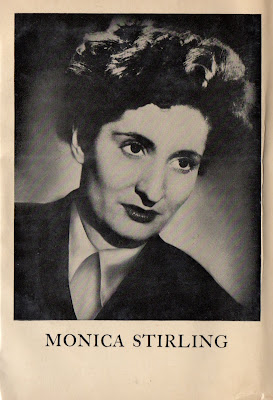
Monica Stirling (author pic found
by Kim Kaso, thank you Kim!)

The novel is narrated by Françoise Joubert, an award-winning composer of music for Anton-Giulio's films. Widow of a Resistance fighter, and once a bright young thing herself, Françoise is now constantly aware of her stiff, unemotional face—her "mask"—the result of multiple plastic surgeries following horrific injuries in an air raid. Her telling of the story of a few months in Rome is wry and wise, though perhaps neither so wry or wise about the feelings she hides from herself.

The novel opens with Françoise contacted out of the blue by Peggy Latour, a beautiful former schoolmate who was never really a friend, but who wants to use their connection to get close to Anton-Giulio:

But as the steaming day slowly came to the boil I was gradually overcome by the masochism that obliges me to confront prewar acquaintances with my postwar face.

Peggy is entertaining but shallow, unsatisfied in her marriage to a wealthy Frenchman whose real life has turned out to be far tamer than their wartime experiences together. He spoils her, however, and allows her free use of his money, and she has decided that by financing Anton-Giulio's next film her life will become rather more eventful. She has also come under the influence of Princess Valeria Girafalcone, a cousin of the film director and a flamboyant "grande-dame" who believes that all women should be practically obligated to have lovers and lead decadent lifestyles.


Françoise in turn soon meets and befriends the lovely, naive Anna-Maria Minsell, the unknown daughter of a Soho organ grinder who will star in Count Anton-Giulio's latest film. The four women interact in various ways, with varying degrees of friendship, jealousy, resentment, and protectiveness, and most often on the topic of Anton-Giulio himself, toward whom each feels possessive and romantic, until finally, in the end, we find which way the wind is blowing from that quarter.

And that's that really. In some ways, it's the fluffiest, frothiest of novels, revealed almost entirely in dialogue—rather like Ivy Compton-Burnett adapted by Vincente Minelli. When I first read it, I thought the novel was irresistibly charming and entertaining but ultimately just a bit of romantic fluff. But when I started going back over it, reviewing the passages I'd marked and the notes I'd made, I realized yet again that Stirling is more subtle than I'd given her credit for. War and Peace this most definitely is not, but as in The Boy in Blue, which I reviewed a while back, it offers some surprisingly powerful juxtapositions between the glamour and frivolity of the characters' present and the traumas of the past. Françoise's frozen, emotionless face may be the central symbol, but there is also, quite strikingly, the scene in which Anton Giulio takes Anna-Maria for a drive along the Appian Way, telling her about the film industry's exciting history and its scandals:

And then they reached the Ardeatine Caves and Anton Giulio forgot the cinema.

This was the place where only a few years ago, well within Anna-Maria's present stretch of memory, the Nazis brought three hundred and twenty-two Roman hostages, kidnapped at random, to be packed into the caves and shot and left, the whole and the maimed mixed in a bleeding shambles, to gasp and die in blackness behind the hastily sealed entrances.

Whew! A real event, by the way, not fiction.

And even in the first conversation between Peggy and Françoise, we get some vivid details of wartime France (perhaps from Monica Stirling's own recollections), a war that ended less than a decade before:

"Was it ghastly?"

I remembered the sunlit summer of 1940, the crowds rushing from Paris, as from a fire, to join the snake-like lines of mattress-topped cars that drove slow, slower and slowest of all just before their closely packed passengers scattered into ditches where the dive bombers still found them. I remembered Nice with its sea and sky and palm trees still as bright as new travel posters and its sidewalks crowded with the most typical of twentieth-century tourists: displaced persons. I remembered the sensation of living in a dull fear-encircled vacuum and the incredulous joy with which I greeted my husband when he arrived hollow-eyed from his narrow escape and long hitch-hike across two countries. I remembered Lyons in the unheated winters, the wind scything between the cliff-like gray houses and inserting itself into the city's labyrinth of passageways. I remembered the turnip meals, the recurrent colds and chilblains, the disinclination to wash in icy water, the sordid temporary lodgings and false identity cards, the drearily uncomfortable atmosphere, and the exhilarating meetings with friends who had also escaped arrest. And then I remembered my husband's arrest and the nightmare that followed.

"Yes," I said, repudiating stiff upper lips, "yes, it was ghastly."

Admittedly, for some the style, relying so much on conversations between the women and on recollections of the past, might feel too uneventful, but ultimately I found it a rather poignant, delicate concoction, like a hothouse flower in perfect but slightly ominous bloom, and I have to say it is now my favorite of Stirling's novels.

French edition

I now have only two Stirling novels left—
Some Darling Folly, reputed to be, like Ladies and Boy in Blue, among her best, and Sigh for a Strange Land, about refugees from unrest in Eastern Europe (presumably the Communists cracking down there in the 1950s, though the precise location doesn't seem to be revealed). There's also one more story collection, Adventurers Please Abstain, which if it lives up to her other collection will be special indeed. I have qualms about finishing with her work, as she has been such a special discovery for me, but how can I resist?

Tuesday, November 2, 2021

"No memories are clearer ... than those one has invented": MONICA STIRLING, The Sniper in the Heart (1960)


Presently I said, "Now what do we do?" As I did so a memory stirred in me: a black-overalled school-girl, I was arguing with other black-overalled schoolgirls about love. Suppose you loved someone who killed someone what would you do? Despite the religious scruples supposed to burden us, the most common answer was help him hide the body. I hadn't imagined I would ever be given a chance to test this. Like many fairy tales, it proved true.

Here I am, continuing my Monica Stirling odyssey (see previous posts here). This is the sixth of her books I've reviewed here, the fifth novel (the seventh she published, out of eight), so forgive me if you're getting bored, but I am deep in my infatuation.

This one seems a bit of an enigma in her body of work. She was perhaps channeling Graham Greene a bit, creating a love story / semi-thriller set in an unspecified Latin American country in the throes of revolution. Vittoria is a young Italian photographer who gravitates to the world's trouble spots, snapping photos to sell to various news magazines. As a result of this, we get occasional bits of jaded dialogue along these lines: 

"I've never been here before", I whispered, "yet it seems familiar."

"Weren't you here for the last revolution?"

"No. That was the year I was in Indo-China."

She arrives in this unstable country and encounters a man from her past--Manolo, a wartime resistance fighter she idolized in her childhood, who also happens to have been the lover of her grandmother, the bold, dynamic woman who raised Vittoria after her mother's early death. She remembers--or, as it emerges, misremembers--him vividly, and they fall instantly and torridly in love (I know, I know). Manolo is involved with gunrunning, and Vittoria gets swept up as well. There is some Didion-esque commentary on U.S. and other international involvement in the revolution, and some danger, suspense, and tragedy.

Implausible as this love story might be (not to mention unsavory, with Manolo now in love with the granddaughter of his ex-lover, whom he once helped with her homework...), it does give Stirling the opportunity to explore one of her favorite themes--the ways in which we're haunted by our memories, accurate or not, à la Patrick Modiano. A central example, from which the novel's title is taken, is the firm memory Vittoria has always had of Manolo telling of his childhood, selling lottery tickets in a cemetery. But no, in fact:

"Paquito, the boy who sold lottery tickets in a cemetery, was a character in a film."

…

You must have heard me describing it to Isabella one evening late, when you were half asleep on that little stool of yours."

"What was it called?"

"The Sniper in the Heart."

Similarly, his bricklayer father turns out to have been someone else entirely:

I had not thought of Giuseppe for years: one of the night people, young and burly, constantly worrying about his wife, who was pregnant and longed for anchovies with peppers. Before the war Giuseppe had been a bricklayer. Dismissing a picture of Manolo's father with a trowel in his hand, I accepted the fact that no memories are clearer, more vividly coloured, than those one has invented.

One feels that the whole romantic element of the novel was constructed to allow Stirling to examine how Vittoria gets caught up in the limbo between her childhood adoration of Manolo and her actual affair with him as an adult. And if only she had come up with a less distressing history for the pair than his affair with her grandmother and helping with her homework!

Monica Stirling with photographer Lee Miller, Paris, 1945

The novel as a whole, too, is outside of what seems for me to be Stirling's most brilliant skill--sophisticated European glamour haunted by the traumas of war. It's well done, of course, as Stirling is nothing if not an elegant, intelligent writer. But it ends up not completely working either as a glamorous romance (a revolutionary capital is not Paris and the romance is a bit creepy) nor as a thriller (the details too vague, the story too short and simple to really develop tension) nor even as a character study (neither romantic lead is very compelling or fascinating, and we're lacking the vivid supporting actors who usually strengthen her novels).

What raises Sniper at least a bit above a mere unsuccessful experiment, however, is as usual Stirling's extraordinary perceptiveness and the sense that, even if she's not always perfect in telling her story, it comes from her own passionately lived experience. I can hardly speculate as to whether Stirling herself ever actually participated in gunrunning in Latin America, but based on this novel I wouldn't dare bet against it, so vividly does she portray the thoughts and anxieties involved:

Moonlight picked out the barrels of their revolvers. I felt rather as I had once done in Africa, in an aeroplane clearly about to make a crash landing on to an exiguous jungle air strip: a moment's internal panic, then a complete lull of all emotions, followed by acknowledgement, curiously dull and unsurprised, of the fact that here, here and now, was the exit towards which we are all travelling.

And one is indeed rather curious from what personal knowledge Stirling wrote the paragraph which opens this post!

I wrote last time about the somewhat excruciating love scenes in Stirling's debut novel, Lovers Aren't Company, and I have to say that I still think she's not at her best writing love scenes (at least not sincere ones--those based, perhaps, on her own experiences?), but I should also acknowledge that with the significant caveat of the lovers' past history, she has at least improved significantly here:

Neither Manolo nor I gave a thought to the song's hero, the young man strait-jacketed by a uniform, dragged from home, hungry for love even in the guise of Lili Marlene. Long ago we had thought of him; now we thought only of long ago. Attentively impervious to the music, our minds were invaded by sounds long silent, military boots clumping over cobbled streets, words like the barking of dogs, schnell, achtung, verboten; by lights long extinguished, rays from military torches reaching, like God's finger in old engravings, after fugitives tumbling across the coffee or rose-coloured tiles of rooftops where lines of washing offered ghostly company; by civilian glances long vanished, the welcome in Isabella's face as she turned to greet Manolo, her eyes still young enough to be incandescent, the gentleness in his as he stood, a hand on my shoulder, helping with my homework.

"Long ago we had thought of him; now we thought only of long ago." That's pretty darn good, you must admit.

As a now-devoted Stirling fan, I found The Sniper in the Heart occasionally poignant, good fun and fairly addictive reading, but it's by no means the highwater mark of her work, at least as far as I'm concerned. However, of the three novels I have left to review, two of them seem to be right square in the middle of her wheelhouse--sophisticated tales of postwar Europe--so expect more high points to come. I also have another story collection to go, Adventurers Please Abstain, which could be a treasure itself. Looking forward to sharing them all with you, though I am also now beginning to have the anxiety and melancholy I always feel when I approach the end of a first read of a favorite author's work. As Kate Bush would say, oh the thrill and the hurting...

Wednesday, October 27, 2021

“The whole apartment reeked of approaching drama”: MONICA STIRLING, Lovers Aren’t Company (1949)

[For those of you not on Twitter, apologies for the radio silence the past couple of weeks. We were in New York and DC having a blast and forgetting all about our real world concerns. But I'm back now and nearly finished battling jetlag, and here's a review I wrote just before setting off and never got round to posting.]


During the last few days Francesca had begun to look unusually well, Vittoria unusually unwell
—and, to Corinna's experienced and avid nostrils, the whole apartment reeked of approaching drama.

Of late (as you, dear readers, can readily attest, hopefully not regretfully) I’ve become more than a little infatuated with Monica Stirling. This is the fifth of her ten works of fiction (eight novels, two story collections) that I’ve reviewed, and it hurts me to say that this is the first time she’s disappointed me.

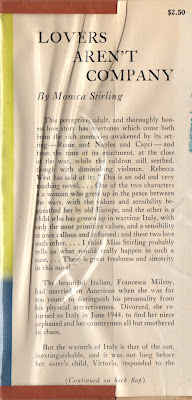
I might have purchased a second copy
of the book entirely for this photo

Lovers Aren’t Company
is the story of Francesca Milroy, a native Italian who has lived in the U.S. since before the war, having married (then amicably divorced) an American, and who is now returning to Italy for the first time since the war ended. Upon her arrival, she finds that her sister Graziella, a famous singer with whom she had a sometimes tense relationship, has died just two months before of appendicitis. Graziella’s husband having been killed during the war, their 14-year-old daughter Vittoria is now an orphan, being cared for by the family’s ever-faithful—if rather prickly—servant Corinna.

Vittoria and Francesca immediately form a bond, but when they take a trip to Capri to visit Francesca’s friend Flavia, their relationship is strained. There, Francesca meets Jean-Claude, a French liaison officer devoted to helping those displaced by the war. Vittoria realizes, even before Francesca does, that romance is in the offing. Terrified of losing yet another person she loves, Vittoria falls in with two other children working with a shady American soldier selling goods on the black market. Things come to a head when Francesca is visiting London and Corinna wires her that Vittoria must surely be dead…


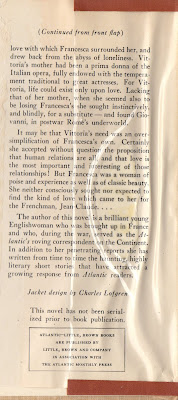
Lovers was Stirling’s debut novel, so she can be forgiven for not having all the finesse she would later acquire. And indeed, there’s a fair amount of evidence of her strengths here, not the least of which is the setting in immediate postwar Italy, a setting Stirling seems to have drawn from personal experience (the flaps above mention that she was a correspondent for the Atlantic during the war). This gives her the opportunity to share some fascinating descriptions of war-torn cities and of a people adapting to peace—for example, pondering the fate of the heroic resistance fighters:

And although we deluded ourselves by paying tribute—horrible, hypocritical, abused wartime verb—to their sacrifice, it was not this that appealed to us but the fact they were outlaws. What would happen now: now that the resistance had come down from the mountains, up from underground, now it was no longer a myth with restorative properties, a tonic for night starvation, now heroes were become human beings—than which nothing is more disillusioning to the improperly developed imagination of other human beings—with personal faults, internecine quarrels, an intransigence developed in them by war and eager to feed on the peace?

Her characters, too, are for the most part vividly real, especially Vittoria and her young friend Giovanni, whose parents were killed in an air raid and who now half expects every scenario to end in disaster, as in this passage in which he watches a bride and groom emerge from a church and begins to imagine he can hear bombers approaching:

The church's somber entrance was brightened by the emergence of a solemn wraith in white muslin, her arm resting, in a histrionic demand for support, upon that of a smiling bridegroom dressed as if to achieve the closest possible resemblance to a black beetle. Momentarily isolated, like flies in amber, in the poetic banality of their situation, the young couple posed with grave compliance for the benefit of clicking cameras and the pleasure of clucking relatives.

…

Nearer and nearer came the sound, reminding Giovanni that no amount of joy could prevent bride and bridegroom being transformed, as others had been before them, into a small pile of jelly beneath a great pile of stone. Bomb damage, he thought: the words horribly fresh, vivid, substantial in his architecture-conscious imagination.

So what was my disappointment then? Well, unfortunately, what Stirling had not yet acquired when writing this novel was a way of writing about romantic love that wasn’t painfully sentimental and stilted. I’m pretty certain that I blushed during the main Francesca/Jean-Claude love scene, and it was neither because the scene was so graphic nor (I assure you) because I am a shrinking violet when it comes to such things. I was simply embarrassed for Striling that an editor had allowed such passages in print for the whole world to see. 

Do I have an example, you ask? Oh yes, I certainly do! How about this?:

Quickly Francesca checked him by laying her hand over his. She wanted time to think. But having got it she found that the acquisition of time did not automatically bring her the power to think. She loved him and he did not love her and he did not love her and she loved him, and why think, why not just take the situation for what it's worth, but what is it worth?

"Francesca," he was saying, the long, soft name brief and sharp upon his foreign tongue, "Francesca oh Francesca ... "

"Jean-Claude," she answered, softening and lengthening the foreign vowels, "oh Jean-Claude, Jean-Claude ... "

Oh Monica, Monica … what were you thinking? And in the midst of my embarrassment I couldn’t help recalling that Stirling’s library cards from Shakespeare & Company in Paris in the very early days of the war have been shared online and reveal her taste for Hemingway (whom I also adore, against all odds), and noting yet again just how awful the Hemingway influence can be in authors who aren’t in fact Hemingway. He would surely have been tempted to challenge Stirling to a boxing match over this passage!

But that’s not all. Here’s another snippet just to be sure of leaving a bitter taste in your mouth:

So this is it this is it oh this she felt, and suddenly she remembered her beautiful mother, her handsome father, and their harvests of raised voices and slammed doors and brandished letters and she thought but it needn't be that way surely it needn't. And then she stopped thinking and remembering: because a cry that was almost a groan was dragged out of her, a cry of longing such as she had never known. Hearing it, Jean-Claude kissed her again and again and then took her, with the intense pleasure of a virile man who likes to possess without degrading by possessing.

I’m afraid that in this novel Stirling—in the immortal words of Bon Jovi—gives love a bad name.

However, onwards and upwards in my love for Stirling overall! This one might be a book I’ll only return to rarely, for its visions of postwar Italy, but having read four of her other titles from throughout her career, I’m reasonably confident that there are other excellent books still to come. 

Of course, a weaker novel like this one, among an otherwise strong body of work, raises an interest dilemma. If, just for the sake of argument, we were to consider reprinting Monica Stirling as Furrowed Middlebrow books, should we include the weaker work in the interests of completeness, knowing that some readers will be disappointed? Or do we leave it out, knowing that some readers will then crave the one they can’t have (however unworthy I may think it of craving)? What do you think?

It’s these kinds of questions that keep me up at night…

(Actually, truth be told, they don’t. Very few things are able to keep me up at night—sleeping is one of the few things I do really well—but they do concern me now and then in my waking moments.)

Friday, October 1, 2021

"We all have our troubles": MONICA STIRLING, Journeys We Shall Never Make (1957)

I won’t keep doing a blow-by-blow of all my recent Monica Stirling reading, but if you click the tag at the bottom of this post, you can see all my reviews about her. Having read three of her novels now, I decided it was time to sample her short stories. Her first collection, Adventurers Please Abstain (1952), will have to wait till my library access improves again, as used copies are not within my budget, but I tracked down this, her second and final collection, and became even more enamored with Stirling than I already was.


In some ways, Stirling’s talents--her knack for precise observations of both the micro and macro of her characters and settings, her offhand wit, and her flair for dialogue--are perhaps even better suited for short stories than for novels. And her particular interest in postwar Europe, in ordinary people piecing their lives back together during the advent of the Cold War, make this a particularly intriguing collection. Reading it, I could almost have believed that Hemingway, rather than sinking into narcissistic dreck by the 1950s, had remained in Europe (sans bullfights and misogyny) and kept writing incisive stories that allow us to be flies on the wall at a time of chaos and glamour.

There are 18 stories here, in less than 200 pages, so I obviously can’t mention them all. Some I liked more than others, but there were no duds to be found. The first story, from which the collection takes its title, is particularly reminiscent of Hemingway: Isabelle, a rather posh Parisienne is brought up against the realities of life behind the Iron Curtain when she is tasked by her husband with meeting the train of a Yugoslavian acquaintance, Madame Slanica, at the Gare du Nord and helping her navigate to the Gare de Lyon as she returns home from a visit to England:

As the train began to move she said brightly:

"My husband tells me you have been visiting friends in England."

"That is so."

"How delightful."

"Yes. That is just what it was."

The subdued violence in the woman's voice aroused Isabelle's interest. It suddenly struck her that what she had taken for an ill temper was nothing but a contraction of the facial muscles against tears.

Isabelle learns how difficult it has been for Madame Slanica to get a visa at all:

Isabelle's voice was as low as she felt existence would be with no Paris, no Rome, no London, no New York, no Madrid. Lives without pictures, she thought--and, for the first time since her girlhood, it occurred to her that what she considered romantic love was not the only thing in life worth having.

And it emerges that Yugoslav policy is that a husband and wife can never be granted visas at the same time. Hence the title of the story:

"What about your husband? Does he care for travel?"

"He loves to travel." The sallow face flushed unbecomingly. "As a student he travelled very much. And of the books left us more than half are travel books. Every evening almost we look at them, and at the maps--planning journeys we shall never make--"

It’s quite an opening for the collection, and a perfect distillation of Stirling’s themes--the glamour and sophistication of the haves confronting the losses and complications of the have-nots.

Even more gut-wrenching is the collection’s final story, “Lili Marlene,” which traces the very different fates of three French sisters during WWII and in its aftermath. One marries an officer in the Vichy government, one becomes a heroine of the Resistance, and the third is doomed by her vulnerability to love.

We also get the usual glimpses of theatre life, no doubt drawn at least partly from Stirling’s own family and early life. In “The Old Turtle”, a dresser observes the love life of the actor he has served for thirty years. And in “The Prisoner”, a young prisoner of war finds his future while putting on a play with a fellow prisoner who is a professional actor.


There are several stories about changes in romantic feelings triggered by music, random reminiscences, and ordinary behaviors. In “Bread Alone”, a selfish wife’s eating of her husband’s sandwiches may well determine their future as well as that of another couple. In “The Labyrinth”, an error involving letters to two different women saves a young man from inevitable disappointment. And in “Love in the Third Person”, a French woman reluctantly agrees to have dinner with the American soldier she had befriended ten years earlier.

The most humorous story in the collection is “The Night the Nurse Got In”, about a young wife and mother who suddenly and dramatically falls ill with polio. I know, it doesn’t sound like much fun, but the narrator’s sensibility is often so funny that it’s hard to recall what a near-miss she has. My favorite line is when she is first falling ill:

It had been a nasty day and the cold with which I'd gone to bed was worse. There were spots in front of my eyes, eerie whistles in my ears, and I no longer loved my children.

Not long after, her children arrive home:

At tea-time my children burst joyfully in with the news that their petite camarade Camille had been sick during arithmetic. I eyed them wearily. Tomorrow I had better ask Unesco about homes for backward children.

And then there are her observations about her smug, knitting nurse:

"We all have our troubles," click, click, "don't we?" she said with relish. "Rich or poor, young or old, we can't escape indefinitely, can we?"

Again I was reminded of school: preparations for examinations, references to the ubiquitious examiner who might trip us up on this or that sly question. Was life a series of booby traps? Looking at the nurse, I felt that it was--and it struck me that the popular conception of the knitting revolutionaries around the guillotine was inaccurate. They had not, probably, been furious harpies, driven by conviction to yearn for blood, but comfortable, knitting home-bodies, anxious to convince the severed heads that we all have our troubles.

Most of the stories aren’t as funny as this, though there is very often a wry sensibility that charms.

I’m really looking forward to Stirling’s other story collection now. And perhaps it would be wise to do some digging for any stray stories that appeared in magazines and never got collected? Add that to my things to do list. But for now, it will be on to another of her novels. I’m thinking it might have to be Lovers Aren’t Company, her 1949 debut, set in immediate postwar Italy...

Friday, September 17, 2021

“The plants were silent”: MONICA STIRLING, The Summer of a Dormouse (1967)

The US cover is bland, but...
The driver got out of the taxi and opened the door for his passengers. There were two of them, an elegant dark woman, apparently in command, and a flaxen-haired girl in white. Her face was almost as pale as her coat and her great dark eyes had a drowned look. A shock went through me. I was sure I had seen that face before, that face and that expression. Inside the house a bell tinkled. I wondered why the girl was crying, since she was in time for tea.

My Monica Stirling odyssey is continuing unabated. Having started with her fourth novel, The Boy in Blue (1955), then stepped back to her second, the very charming grownup school story Dress Rehearsal (1952), I’ve now leapt forward to her eighth and final (and oddest) novel.

The Summer of a Dormouse (1967) is set at the Manor House, a surely rather idealized Swiss psychiatric clinic where the patients seem to live idyllically--properly medicated, free to socialize and to come and go as they please, and without any major restrictions (though some patients have anxiety about being sent to “the Villa,” a more secure and stringent facility across the park, if their conditions worsen).

.

...I rather think it's better
than the UK cover

The main focus here is on Karen, a young actress who has attempted suicide as a result of the a fraught relationship with Louis, the Svengali-like film director who has molded her screen presence, and his wife Ingrid, who checks Karen into the clinic. But there’s also a compelling array of supporting characters. There’s Carlos, the eccentric narrator of some sections of the novel (including the quote above), and his friend Maria-Pia, a Spanish woman with religious delusions, who has been “rescued from a nauseating asylum in another country in which she had for years existed rather than lived”. There’s the Signora, the oldest patient, believed to have been a famous dancer in her youth, and Sidonie, “being treated for a breakdown caused by having borne five children in seven years and raised them with little domestic help”, who is now understandably terrified of sexuality.

There’s Willi, a brilliant biology student who has had a breakdown, Ross, a surgeon overcome by the stress of his profession, and Herr Pilsner, an impossibly boring man who talks continuously, spouting dubious facts and doubtful ideas. And there’s the staff of the clinic, who are largely ideally brilliant and compassionate, with the exception of Klaus, the predictably sadistic German nurse who decides to supplement his salary by robbing the wealthier patients (but who of course gets his comeuppance in the end--albeit very much at the expense of another character).


Dormouse
is one of those novels that doesn’t have a great deal of plot in the ordinary sense, though it’s no less entertaining for that. We follow this intriguing cast of characters over the course of several months, with a particular focus on Karen and her gradually renewed interest in life via her friendships with the others. Stirling manages to find the humor in their situations, but always with sensitivity and compassion. Herr Pilsner perhaps comes in for a bit of mockery, but then, he really is quite boring… Otherwise, the humor grows naturally from the characters’ interactions, rather than in any way making light of their problems. Not a small accomplishment for the mid-1960s, I think.

One of my favorite bits of humor comes from one of the sections narrated by Carlos:

We were so absorbed by our conversation that we did not realize we were not alone until we heard other voices. At first I was afraid they came from the plants, which had not addressed me since Maria-Pia came. But no, the plants were silent.

The Summer of a Dormouse appeared just two years after Stirling’s acclaimed biography, The Wild Swan: The Life and Times of Hans Christian Andersen, and as critics were quick to point out, it’s more than a bit permeated by Anderson and his tales. It’s an odd sort of fairy tale version of Thomas Mann’s The Magic Mountain, but with more glamour and wit. (Just try to picture that!) It’s probably not the best of Stirling’s novels, but it is genuinely intriguing. One feels that she rather let herself go here more than in her other work, following her own fancies regardless of their commercial appeal, and such books are always interesting entries in an author’s oeuvre.
NOTE: The comment function on Blogger is notoriously cranky. If you're having problems, try selecting "Name/URL" or "Anonymous" from the "Comment as" drop-down (be sure to "sign" your comment, though, so I know who dropped by). Some people also find it easier using a browser like Firefox or Chrome instead of Internet Explorer.

But it can still be a pain, and if you can't get any of that to work, please email me at furrowed.middlebrow@gmail.com. I do want to hear from you!