Showing posts with label Jane Oliver. Show all posts

Monday, November 27, 2023

"You're just the very person": ANN STAFFORD & JANE OLIVER, Cuckoo in June (1935)


Cousin Dorothy clutched me by the arm and murmured: "Kit, dearest, why didn't I think of it before? You're just the very person ... "
I thought of Bazaars and Sales of Work and Committees and Church Charities and the devil and the deep sea. But Cousin Dorothy went straight on. "It's about Verity, darling. We're so worried. I simply must tell you from the very beginning ... "

And this is how Kit Findlay, who worries that she's a bit past it now that she's in her thirties (!!), gets pulled in to take her rather shallow, flirtatious young cousin Verity first halfway across Europe, and then, since Verity finds charming men everywhere she goes (even a tiny village in the Swiss Alps), back to her brother Benjamin's idyllic farm in Hampshire. As Kit puts it:

A good deal has been said and written about the trials and joys of dodging chaperones, but as far as I remember, very little about the arduous amusement of not letting oneself be dodged.


First they go to stay with charming Tante Hélène in Rouen, meeting handsome John Hobart on the train, who has the darnedest knack for popping up in unlikely places. When he pops up once too often, Kit, against the advice of Tante Hélène (who might see more than they give her credit for), rushes Verity off to the Alps, where Herr Albrecht, a climbing aficionado, takes a bit too much of an interest. So before long it's back to the farm with young, handsome brother Benjamin (what could go wrong?), only to find that John Hobart has established a riding club nearby. The comedy continues with riding lessons and tennis tournaments, Verity at the end of a few months is a rather different person, and Kit may find that she is too…

This is all great fun and good for chuckles at various points. In particular, the pair's train journey had me giggling quite a lot, particularly as I realized that I am indeed thoroughly English in my heritage—just as my genealogy would suggest—as I completely relate to Kit's contempt for people who hate fresh air. Here are a few memorable excerpts:

I saw at once that we weren't going to be lucky. One glance at the woman settling herself into the corner by the door made me sure we had one of the Window-Shutters: she hadn't those check clothes and double-chins for nothing.

…

The elderly body with the hatpins seemed to be asleep, for her head was rolling about as if someone had wrung her neck. But she managed to mumble thanks when Verity said she could put her feet on the opposite seat if she liked, while she was in the corridor. It was a relief to hear her speak after watching that wobbling head in the eerie light from the corridor and wondering whether people ever did die of a night in the train as well as feeling like it.

…

After a while I began to wonder where Verity was, and whether it would be a good plan to try and wash now before the corridor filled with refined people pretending they had come out to see the fields of France and less refined ones rattling the door of the Toilette at the end.

I read and very much enjoyed Stafford & Oliver's other three early collaborations—see here and here—last year, but when I acquired a copy of Cuckoo in June (at rather a hefty cost—let's not talk about that), I opted to save it on my TBR, reluctant to finish their fun authorial teamwork (both Stafford & Oliver went on to publish many more novels individually, and even went back to collaborating, under the pseudonym Joan Blair, on a number of romance novels, but these clearly have a very different tone from the four early works published under their own names). But having recently grown a bit fatigued with reading photographed books on my Kindle (some of the pics sadly demonstrating all too clearly that my hands have grown shakier as I get older), I plucked it off the shelf and settled in to enjoy. It's a perfectly charming read, and I wish Handheld Press (who reprinted the earlier Business as Usual) or some other publisher would bring the remaining three titles back into print.

This book, too, is remarkable because it "has the distinction of being the first modern novel published with hand-coloured plates; it has eight pictures in colour, and in addition there are numerous line-drawings." Ann Stafford's drawings are as delightful as ever here, and the ones with colour do add a certain dazzle.


Friday, July 22, 2022

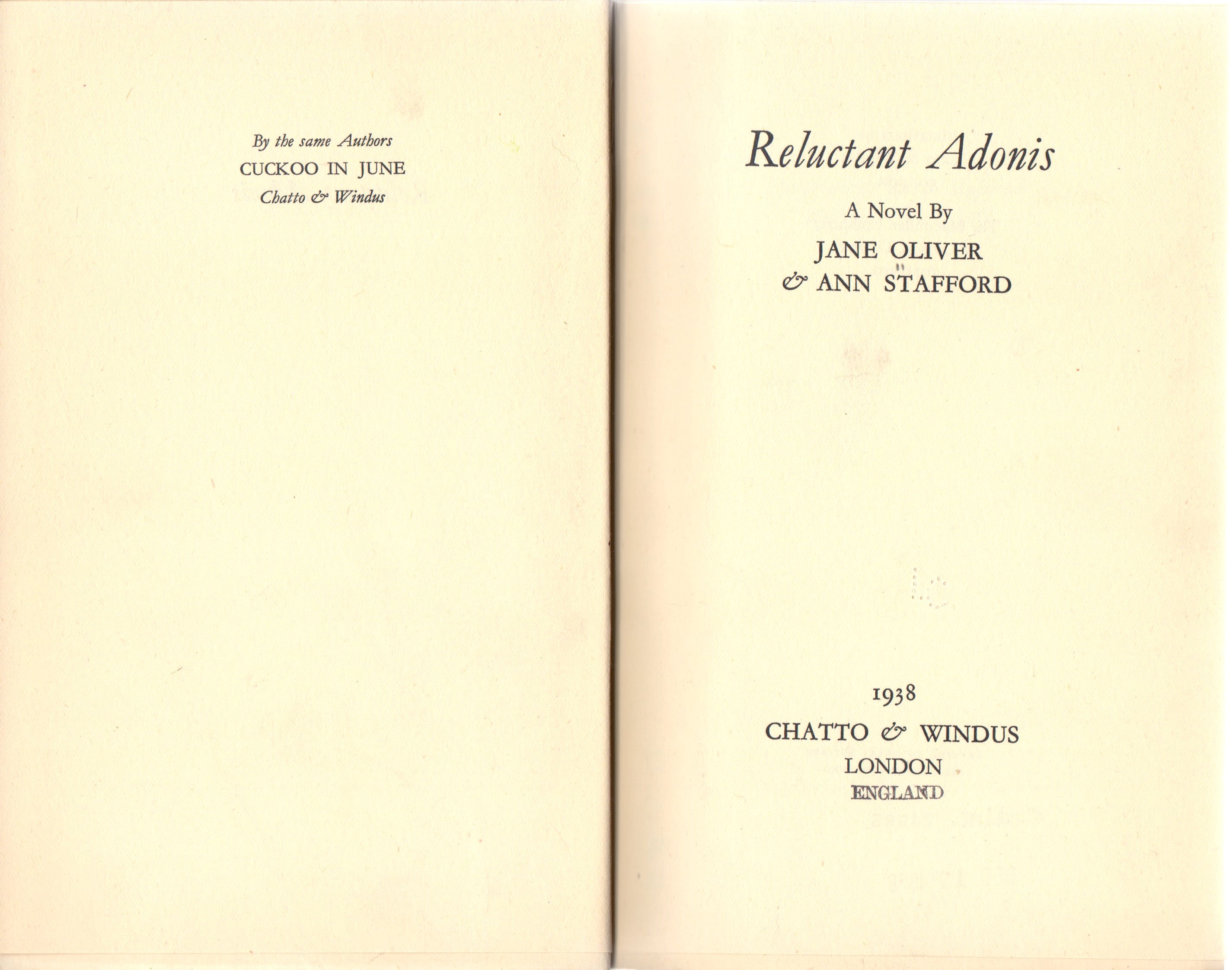
The Seventh Commandment: ANN STAFFORD & JANE OLIVER, Reluctant Adonis (1938)


Gerard said: "I shall never be able to hold up my head in Baronbury again."

Julia went on turning her patience cards over in neat groups of three. But she cheated just enough to bring the king where she wanted it, and slapped it complacently on top of the queen. "Then go and hold it up somewhere else," she said.

Gerard Munro is, first and foremost, a gentleman, and (at least at the opening of Reluctant Adonis) a rather stuffy one at that. He's not having nearly as much fun as his friend Julia Taunton, taking the high road by spending the night in a hotel room so his philandering wife Daphne will be able to divorce him without getting her well-manicured fingers dirty. Julia sees it all as a lark—"I came here to break the seventh commandment as a purely friendly gesture, I admit, but I wish you could see your way to being a little less disheartening about my company"—but Gerard is comically upset and offended by it all. 

Think Katherine Hepburn or Irene Dunne as the wry, cheerfully maneuvering Julia, and surely Cary Grant was made for the role of the easily flustered, stuffy-but-with-potential-to-loosen-up Gerard. It might not have been quite on a par with masterpieces like Bringing Up Baby or The Awful Truth, but surely Reluctant Adonis the film would have been a couple of hours enjoyably spent—as indeed was the novel. Perhaps Ann Stafford and Jane Oliver were even hoping to make their fortunes in Hollywood, as they are certainly rather in screwball comedy vein here, if perhaps not quite so irresistibly as in Business as Usual and its sequel Cook Wanted, which I discussed here.

One of my happiest achievements while reading Reluctant Adonis was to finally actually look up and come to to understand (I think) just what the heck a "decree nisi" actually was. After Gerard and Julia spend their awkward and (on Gerard's part) grumpy night together, we skip ahead to Daphne getting hers, but then there are all sorts of complications and potential complications. I think I'd always assumed that a decree nisi was basically the finalization of a divorce, but no! I was underestimating the extent to which silly bureaucracy has seen fit to attempt to regulate the emotions. In fact, a decree nisi merely defines a period of time (often six months) after which, if no offensive behavior has occurred, a divorce will become final. Ironically (and idiotically), this means even offensive behavior on Daphne's part, though she was (officially) the unoffending party. Fortunately, I've never needed personal knowledge of such things (though Andy might wryly note that there's still time).


The logistics of a 1930s divorce might be unbelievable to today's readers, but it's nothing compared to the implausibility of Gerard receiving, on the day Daphne gets said decree nisi, a letter from his uncle's solicitors informing him that he's inherited his uncle's fairly impressive fortune and house in the country. As Gerard finds himself, a soon as word of his divorce spreads, absolutely under siege from single women frantically setting their caps at him, he seizes the opportunity to retreat to his new country estate, complete with an impeccably proper, woman-loathing butler. Once there, however, his blissful peace is shockingly disturbed by the realization that his uncle, a fan of airplanes, had leased neighboring land to a Flying Club, with the result that planes are regularly roaring overhead. Gerard soon comes into conflict with the band of eccentrics who use the club, which includes—who would believe it?—Julia herself, an efficient and enthusiastic pilot. Determined not to be outdone by the annoyingly competent Julia, Gerard himself takes up flying, and the rest is, if not surprising, at least solidly entertaining.

Ann Stafford and Jane Oliver were themselves both licensed pilots, so part of the fun of this novel is its entirely believable descriptions of the experience of learning to fly, and the exhilaration of actually doing it. The humor of the story is a bit exaggerated and strained at times, but I have a high tolerance for silliness, so I enjoyed it, and there are some genuine chuckles, particularly in regard to some of the oddballs at the Flying Club and the death match that develops between Gerard's misogynistic butler, Burtenshaw, and his housekeeper Mrs Rossiter, whom Gerard brings down from London with him:

"Thank you, Burtenshaw, thank you."

"Thank you, sir," said Burtenshaw, as he watched his master stride away, rather more slowly now that his greatcoat was flapping about his legs, towards the Flying Club. Then he squared his shoulders and went back to prepare Gerard's lunch behind locked doors, while Mrs. Rossiter clucked over the dust in her employer's bedroom, and took down all the pictures and moved out all the furniture, so that she could be sufficiently overcome by fatigue to make Burtenshaw spend the afternoon moving it back again.

Reluctant Adonis was the fourth and final novel published jointly under Stafford and Oliver's real names, following Business as Usual, Cook Wanted, and Cuckoo in June. These four works, the first two published by Collins, the latter two by Chatto & Windus, seem to be unique among the authors' oeuvres—light, charming, romantic frolics. Sadly, Adonis, alone among the four, is not illustrated by Stafford's charming line drawings. The two authors went on to publish numerous novels separately as well as a number of romances written together but published under the name Joan Blair. I've managed, of course, to read the books completely out of order, but this means that I still have the third, Cuckoo in June, sitting expectantly and very prettily on my TBR shelves. I anticipate that it will, like Adonis, be a delightful way of passing a few hours, even if it's not necessarily a masterpiece of the genre!

Friday, June 3, 2022

"T for tiresome, S for stupid, D for dull and B for bad-tempered": ANN STAFFORD & JANE OLIVER, Cook Wanted (1933)


SPOILER ALERT (sort of, vaguely): As many of you undoubtedly know, a wonderful book called Business as Usual by Ann Stafford and Jane Oliver has been reprinted in the past couple of years by Handheld Press (see here). It's the completely irresistible tale of Hilary Fane, who, engaged to an unbearable prig who can't marry for another year, decides to take that year to support herself in London, and finds work in a London department store. Her diplomacy and practical thinking (rather than her clerical ability, which leaves a considerable amount to be desired) catch the attention of management—rather unrealistically quickly—and she advances at breathtaking speed in her career. (One feels that if other events hadn't intervened, she would have been running the department store by the end of her second year.) Along the way, there's loads of fascinating and entertaining detail about the running of the library and book department of the store and their quirky inhabitants. Do absolutely read that book, if you haven't already, but none of this is the spoiler. The spoiler is that I put in an interlibrary loan for another Stafford & Oliver novel, Cook Wanted, apparently published the same year as Business as Usual, primarily because it was one of the only of their books that I could get hold of, and discovered only after its arrival that it is in fact a sequel, of all delightful things, to BAU. For that reason, it's impossible to write about it without taking for granted the conclusion of the earlier book—though in all fairness you'd have to be a pretty willfully obtuse reader not to see that ending coming by about a quarter of the way into the novel anyway.

Still, be warned! 

I went back to dinner with Aunt Bertha afterwards and asked her weakly if she didn't find voluntary work quite exhausting. She said: "Well, Hilary darling, between ourselves, I sometimes think it isn't the work so much as the Workers." And we would have champagne, she said, because it did Pick you Up. And after dinner I felt much better, but just as I was thinking blissfully of getting to bed really early she suddenly began to burrow in her bag, and sent her maid to search all her pockets and attache-cases and alternative handbags for her Diary. She was quite hysterical about it. "There are Things in it, my dear," she said dramatically. I asked: "What Things?" and she said: "All the names of the people on my committees. And I'm bad at remembering about people, so I just marked them with T for tiresome, S for stupid, D for dull and B for bad-tempered." So I said soothingly that that would be quite all right for nobody would ever guess what she meant.
"Oh, yes, they will," said poor Aunt Bertha, "I felt it would be so much more business-like if I put the code in too. Just in case ... "

Although published the same year as Business as Usual, Cook Wanted takes place several years later (the first book ends in 1932, so presumably we're at least to 1938 here if one were being boringly numerical). Hilary Fane is now Hilary Grant, and business has taken her loving husband Michael to Canada for six months, leaving her home alone with just their 5-year-old son Adam, her good friend Mary Meldon, who comes to stay during Michael's absence, her various servants (including several troublesome cooks, which provide the loose structure of the book), and of course her social activist Aunt Bertha, "addicted to committees". Also providing lively difficulties are Curtis-Fitton, Adam's hoity-toity nurse, Rutherford Worsthorne, a preeminent archaeologist met briefly in BAU and here figuring more prominently with his bull terrier, and Basil Rainford, Hilary's former fiancé, who is somewhat regretting having allowed Hilary to get away (though he's still as much of a prig as ever).

Apart from dealing with various entertainingly chaotic domestic staffing crises, Hilary in this volume gets pulled into Aunt Bertha's world—to serve as Honorary Secretary of the Federated Women Citizens, and further in when when she's drafted, despite her best efforts, to a subcommittee:

But when one of the least hard-bitten and hand-woven members told me that her sub-committee was drafting resolutions on Overtime Among Office Workers (Female) I was tempted—it's still a sore subject with me. And when she mentioned the value of my personal experience at Everyman's and wondered if I realised that under Clause CCCXVIII of the new Bill millions of typists would be working night as well as day, I took fire and followed to the slaughter. As a result I had a Sub-Committee for the Regulation of Women's Working Hours from ten till lunch-time and the Central, All Purposes, goddam-awful Committee Meeting from two o'clock till five-fifteen.

Things become more complicated when Hilary is able to snag Mary the job as editor of the organization's paper, only to find her soon after instigating a strike by the group's own typists, whom they are ironically exploiting mercilessly. Then Basil catches her at a weak moment in Michael's absence, Adam has a health scare, and she and Mary hit the rocks over Hilary's attempts to throw Mary together with Rutherford Worsthorne. Oh, and she has an unexpected encounter with another supporting cast member of BAU as well.


It's all completely irresistibly entertaining, and like
BAU it's accompanied by Ann Stafford's charming line drawings, used to illustrate her letters to Michael in Canada and to her family in Edinburgh, which are the primary content of the novel, with occasional memoranda and other insertions. If it's perhaps slightly more uneven than the first book, as most sequels are, it was still a pleasure to read, and I'm so glad my random ILL request happened across it. 

Unfortunately, based on a Twitter comment from Kate at Handheld when I tweeted about finding the book, it seems that they have no intention of reprinting this one. She suggested that there was a sort of deal-breaker in it. I didn't notice anything major along those lines, though there are some minor irritants, like when Hilary is seeking a school for Adam and Aunt Bertha refers to "backward cases" as being "catching". Not atypical for the time, but still grating to our ears. There might be something else that went over my head, however.

Be that as it may, there are two more amusing and/or interesting passages I'll point out. One, purely for giggles, follows a jaunt Hilary and Mary take into the country, going for a long horseback ride, only to discover after resting at lunch that they are, shall we see, a bit out of practice:

After that the weather improved and we left the pub after lunch for a Long Walk. But we found that we hadn't counted on the after-effects of our first ride for years. We were both just birpling. Like two old, old bodies. I said that I was sure it couldn't be just stiffness: it must be Rheumatic Fever. And Mary said, surely not, but that it was certainly very odd and we would look up the symptoms in Black's MEDICAL ADVISER as soon as we got back to London if rigor mortis didn't set in first.

(BTW, I am now resigned to feeling exactly this way the day after each and every workout, no matter how frequently I exercise. I remember the good old days when I was only sore when I hadn't worked out for a long time, but those days are sadly in the past. Now it's 24/7 sore.)

The other passage is a striking one from a meeting Hilary has with Lady Agnes, the elderly founder of the Federated Women Citizens:

After that Lady Agnes kept us both for dinner and talked about Hunger-Striking and insides of Prisons and point-to-points in Ireland and religious revivals in Wales and Vice-Regality in India until we felt that Commonweal House was a very small pea on a very large drum. As intended. Bless her. I asked her, as I've always wanted to ask one of the Militants, how so many really brilliant women came to do things like setting pillar-boxes on fire and chaining themselves to railings.

And Lady Agnes said: "Well, my dear, when you give men a series of reasoned logical arguments, and they pat you on the shoulder and say 'Run along, little woman; government's a man's job,' you just naturally put out your tongue at them. Besides, it's the only way of getting their attention."

It seems frankly as though we may need to start smashing windows and setting pillar-boxes alight again…

I did manage, by the way, to snag one other Ann Stafford novel via interlibrary loan, a postwar title called Near Paradise (1946), and I've apparently just inadvertently purchased two more (I was just seeing what was available—truly I was!). And I might have laid hands on the one remaining copy I found for sale of her third novel with Oliver, Cuckoo in June, which looks delectable but does not appear to continue Hilary's story. (Perhaps just as well, because at the rate Hilary was conquering realms, a couple more volumes about her would surely have led to her being Prime Minister during World War II instead of Churchill!)

But first and foremost I am also going to finally get round to reading Stafford's Silver Street (1935), which Greyladies reprinted a few years ago and which appears amazingly to still be available from them (see here). As usual, Shirley Neilson was the trailblazer who first discovered Stafford's charms, so I can only assume in advance that Silver Street is a particular treasure.

As for Oliver, I had come across a wartime novel of hers, The Hour of the Angel (1942), a few years back, read just a bit, and quietly returned it to the library. Her husband, John Llewellyn Rhys, whose name has been immortalized by the literary prize she created in his honor, had died only the year before, and the book was very much about her grief and also her interest in spiritualism, which apparently only increased in later years. Not to my own particular taste, so I think I may stick with Stafford or the two's early books together under their own names (they later wrote billions of Mills & Boon romances together under the name Joan Blair, but I'm not sure I'll need to delve too deeply into those either—okay, perhaps not billions, but quite a lot of them). But if you know of a Jane Oliver novel you really recommend (or a good Stafford, for that matter), do let me know. I'm on the prowl, as always.
NOTE: The comment function on Blogger is notoriously cranky. If you're having problems, try selecting "Name/URL" or "Anonymous" from the "Comment as" drop-down (be sure to "sign" your comment, though, so I know who dropped by). Some people also find it easier using a browser like Firefox or Chrome instead of Internet Explorer.

But it can still be a pain, and if you can't get any of that to work, please email me at furrowed.middlebrow@gmail.com. I do want to hear from you!