
This
one is apparently not even particularly obscure or little-known, so I'm not
sure how I had missed it for all these years.
The rollicking, hilarious memoir of Charles Darwin's granddaughter, who
became an acclaimed artist in her own right, Period Piece is apparently already familiar to many of you. Therefore, there's little need for me to go
into depth about it and I can—out of pure indulgence—just share a few of my
favorite passages.
When I
first picked up Period Piece at the library book sale a while back, I was intrigued by its dust jacket, but I wasn't completely
sure I had to bring it home with me until I read the first page or two of Raverat's
introduction, in which she quotes extensively from her American mother's
hilarious (sometimes intentionally, often unintentionally) letters back home to
the U.S. from her trip to England, during which she met her future husband. The letters, and Raverat's own commentary on
them, neatly set up the theme of what an astonishingly different—and often
ridiculous—world was that of the Victorians compared to more recent periods. Perhaps it was also meant to be implied that our own period might appear just as ridiculous to future generations.
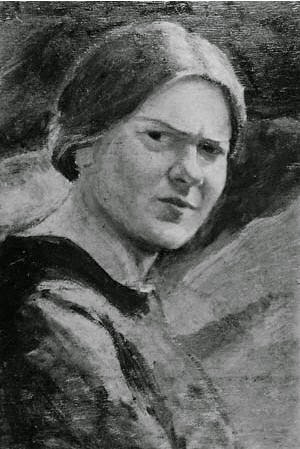 |
| Self-portrait by Gwen Raverat |
Those
preliminaries were enough to get the book to my shopping cart, but ultimately
it was Raverat's own wonderful, nonconformist attitudes as a child that made
the book irresistible. Her
perspective—in her early days at school—on the strange beasts around her seemed
like my own feelings right up through high school:
Not that I wanted to leave school; I wanted to stay on, if
only I could manage to bear it; for I was very curious about the extraordinary habits
of the girls. For instance, that first day, they were all singing: 'I am the
Honeysuckle, You are the Bee.' Why? What on earth was it? (I had never heard a
popular song in my life.) And they were all busy making hat-pin knobs out of
coloured sealing-wax. Now why in the world did they like doing that? Nearly everything
they did mystified me.
…
For the rest, school is rather a dim memory to me; all hurry
and scurry; beginning in the morning with the sound of the housemaids' feet
racing along the passages, as they carried great cans of water for the
saucer-baths, which they pulled out from under our beds; and then, all day long,
running myself like a hare, from place to place, at the sound of the bell, in
the hopeless endeavour not to be late. And then, the continual strain, the
effort, of trying to understand, to imitate, to conciliate the indigenous
population of that foreign land, where I never could get higher than the
tolerance of 'It's only old Genie' from the kinder inhabitants.
Raverat's
particular childhood bête noire, however, was the dance class she was forced to
attend. Although I never had to face the
indignity of a dance class (not, I realize, an indignity for many children not
as hopelessly clumsy as myself), I felt very much the same about P.E.
courses. Here is Raverat recalling her
unfortunate dance instructor just at the moment of calling students to practice
the moves together:
It was then that I hated her worst of all; and I stood there wishing
death, torture, and the undying worm on the poor lady.
So, in revenge, I did it all as badly as possible; kicked the
heels of the child in front of me when we were marching; and toppled over sideways
when we were kneeling on one knee and supposed to be making graceful
semicircles with our arms.
Alas,
I never needed to intentionally be clumsier than I really was. Oh, how the memories come flooding back!
The illustrations for Period Piece, line drawings by Raverat herself, are almost half the fun of the book. The drawings and their captions are sometimes just as hilarious as the text, especially when she portrays herself as a child, usually in the most unflattering and befuddled-looking way possible, as when encountering the strange behaviors inspired by romance:


Finally, I just have to share a random passage that somehow made me laugh harder than any other in the book. Raverat is describing a
boating mishap, and the final line is still making me chuckle even as I write
this:
Now among our guests were two sisters, whom I shall call
Cordelia and Jane. The boats were moored in very deep water, beneath a steep
bank, perhaps four or five feet high, and Cordelia and I had scrambled into one
of them to receive the baskets, when Jane appeared at the top of the bank. A
man, standing in my boat, held out his hand and said brightly: 'Jump in.' So
Jane simply jumped! From that height! She hit the edge of the boat, which would
certainly have upset if I had not instinctively thrown all my weight over on the
other side. After wobbling wildly for a moment both she and the man, who tried
to hold her, fell with a terrific splash into the deep water. Then, by my side,
Cordelia rose grandly to her feet, and with a ringing cry of, 'Oh, Jane!'
simply stepped into the river, no doubt preferring a watery grave to living
on alone…
If
you're a fan of humorous, cheerful memoirs, and you haven't made the acquaintance of Darwin's granddaughter yet, then
what on earth are you waiting for?!
